Ice Skating on a Theatre Stage by Hieronymus Bosch
When Your Mind Refuses to Believe Its Own Eyes, You Lie That You Believe in God.
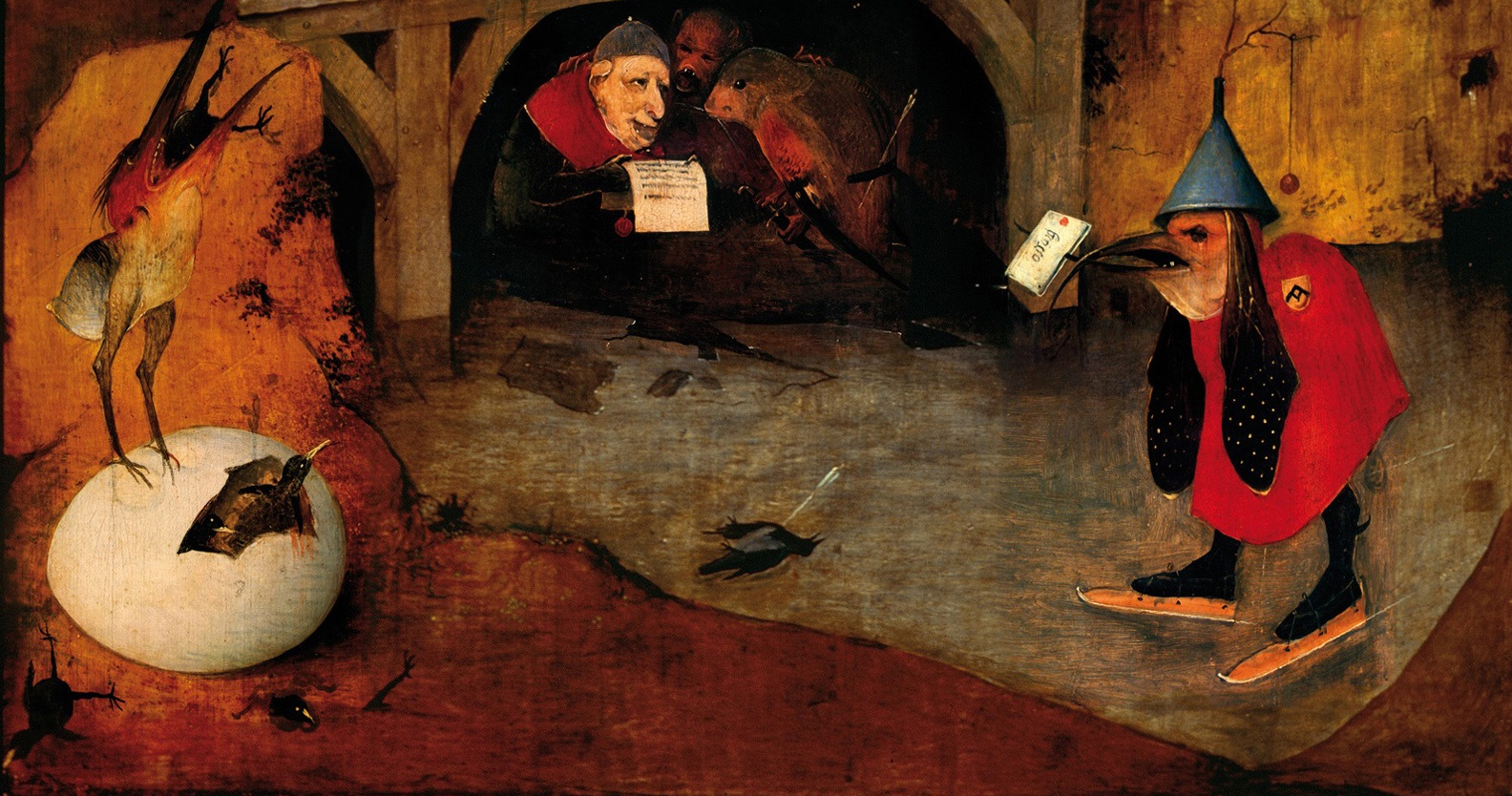
Thank you for taking the time to examine this remarkable fragment from Hieronymus Bosch’s triptych, The Temptation of Saint Anthony.
Indeed, ice skates already existed in Bosch’s time, and at first glance there seems to be nothing unusual about them—especially when we are looking at a painting by the master of the unusual himself.
However, things are not so simple. Bosch’s paintings foreshadow the biblical Revelation—the very process with which you have come to engage in this book.
Perhaps I should immediately explain why there are so many berries in Bosch’s paintings. The reason lies in the second meaning of the word berry. The sound ber- points to something buried—that which has been hidden. Thus, a berry is that within which something has been concealed.
Notice that Saint Anthony himself is depicted in this painting as literally buried. Moreover, he is buried in a position in which no one would wish to be unearthed. By doing so, Bosch confirms the very principle: yes, in my paintings the essence of the berry is the burial of sacred knowledge. This is where the holy meaning lies, hidden beneath a veil of vulgarity.
Now consider the details. Bosch painted an ice-covered stage. Look again at the curtain and at the prompter’s box.
Yet fully developed theatrical performances on ice, in my opinion, truly emerged only with Tatyana Tarasova’s All Stars company at the very end of the 1980s, on the threshold of the 1990s. And, as far as I know—and this is something I know firsthand—the technical production of those ice spectacles was carried out by the English company Wild Rose Productions.
I would not mention this unless it later enabled you to discover something truly significant for yourself.
For the moment, however, let us focus on one distinguishing feature.
Examine the emblem on the skater’s left shoulder. Of course, an open book shown upside down is itself a symbol of Revelation, almost corresponding to the Egyptian hieroglyph. But what I wish to point out now is a very specific resemblance—so precise that it can be nothing else.
Where am I leading?
Hieronymus Bosch was a prophet—a kind of person in whose existence people today are increasingly unwilling to believe, because everyone measures the abilities of others by their own and therefore assumes that no one can truly know God personally.
Had Bosch wished, he could have painted genuine Gold Seal blades on the skater’s feet. But that would have contradicted the meaning of biblical providence.
Instead, with the lightest of touches, Bosch placed an emblem upon the skater’s left shoulder—an emblem that cannot be mistaken for anything else.
I shall show you the school uniform worn by every boy in the Soviet Union between 1970 and 1988. On the left shoulder was an emblem of precisely the same form and meaning: an open book together with the rising sun. I shall also show you a frame from a Soviet film in which this emblem is clearly visible.
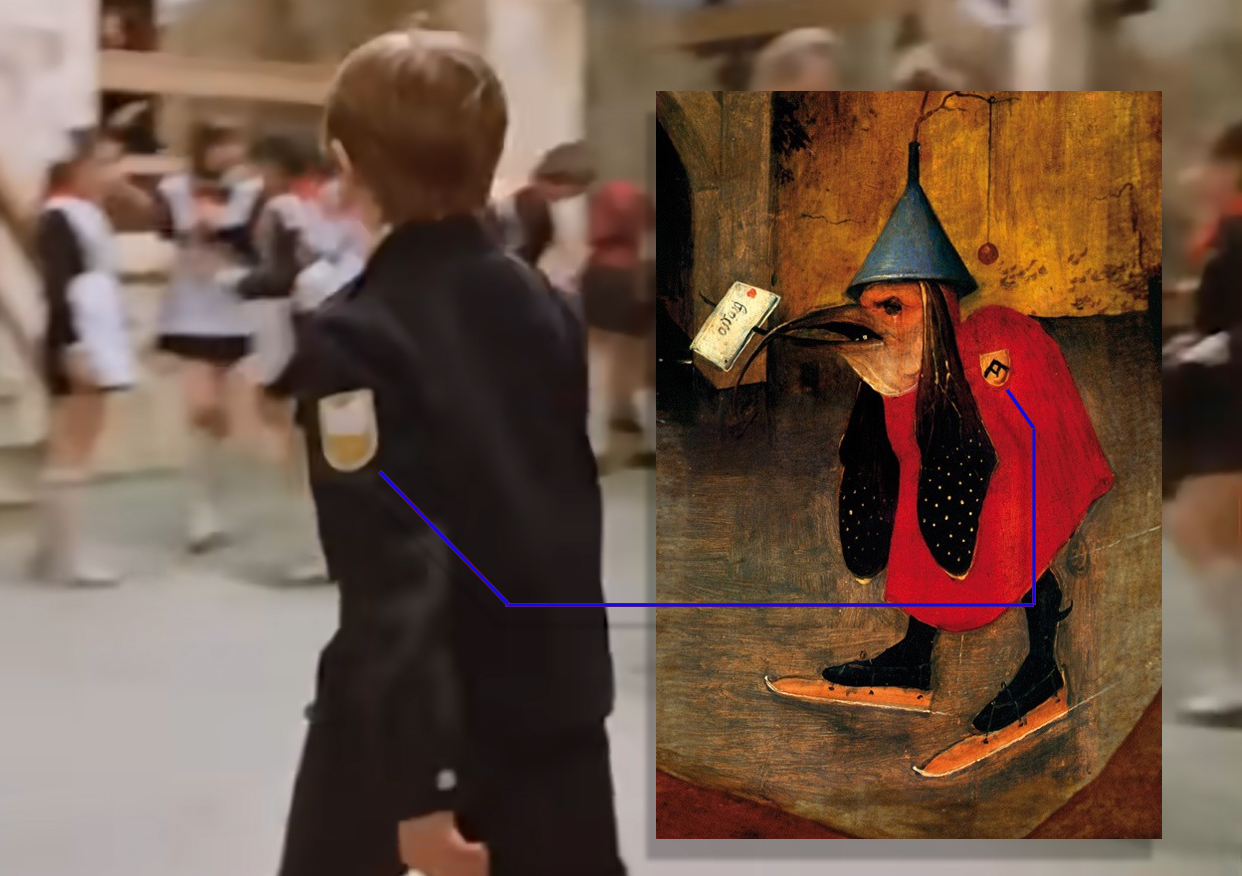
Please take into account that both emblems express the very same essence—the revelation of knowledge. The inverted open book signifies knowledge so profound that it completely overturns one’s previous understanding.
Then ask yourself a simple question:
Have you ever seen such an emblem anywhere else besides this painting by Bosch and that very specific Soviet school uniform belonging to a very specific place and time?
Now that you have already realized that I intend to reveal the Bible to you in an upside-down form, I would like to draw your attention once again to the finer details of the “letter carrier.”
Why is there a funnel upon his head? The essence is that, when the funnel is turned upside down, the very Tree of the Knowledge of Good and Evil grows out of it. It is depicted precisely in the form in which it appears to mankind today, when no one knows what it truly represents.
Forgive me; I should not be too lazy to explain everything thoroughly.
Hieronymus Bosch depicts a funnel several times in his works, and by it he means the Bible.
The essence of this object is revealed through the Russian word voronka, which contains the mind-form VOR, whose essence is inversion.
Both the funnel and the Bible are truly used according to their purpose only when turned upside down.
And notice one more detail: the very first cranberry hangs from that tree.
Look carefully at this cranberry hanging from a string. Why?
Because it contains a foreshadowing. The cranberry falls, and with it both the tree and the funnel—the Bible itself—are turned upside down.
Hieronymus Bosch found a truly ingenious way to express this subtle idea visually.
Why do I say that it is a cranberry, when it is difficult to determine the species of the berry? In reality, simply because no one has ever tried. The cranberry is the only fruit that separates from the plant without a stem or surrounding leaves. A cranberry is simply a little sphere. Every other berry in Bosch’s paintings is depicted exactly as it separates from the plant.
Thus, the introduction with the cranberry and the upside-down book was not accidental. It may seem to you that Bosch consciously created this work specifically for this book. Soon you will discover that such miracles are entirely possible.
If, as I hope, this book eventually reaches the Pope, I imagine one of the first questions he would ask me is:
“How do you know this?”
Rather than answering that question directly, allow me to demonstrate what I mean by Bible in an upside-down form.
We need only a single verse.
Matthew 14:25 (KJV)“And in the fourth watch of the night Jesus went unto them, walking on the sea.”
For nearly two thousand years, everyone reading this verse has imagined exactly the same scene:
Christ walking upon the surface of the water.
Now let us descend one level deeper.
Let us begin with a simple question.
Why the fourth watch of the night?
And while we are asking questions, have you ever noticed something rather curious?
Neither the second watch, nor the third, nor any other watch of the night has ever become the subject of theological discussion.
Only the fourth.
If every detail of the biblical text was placed there intentionally, then the number itself deserves far more attention than it has ever received.
Nowhere in the Bible is any other watch of the night ever mentioned. The Bible mentions only the fourth watch of the night.
If you wish to understand why, we must once again return to the very same verse.
This time, however, it is essential that we examine it in the Spanish version of the Bible.
Matthew 14:25 (Spanish Version)“Mas a la cuarta vigilia de la noche, Jesús vino a ellos andando sobre el mar.”
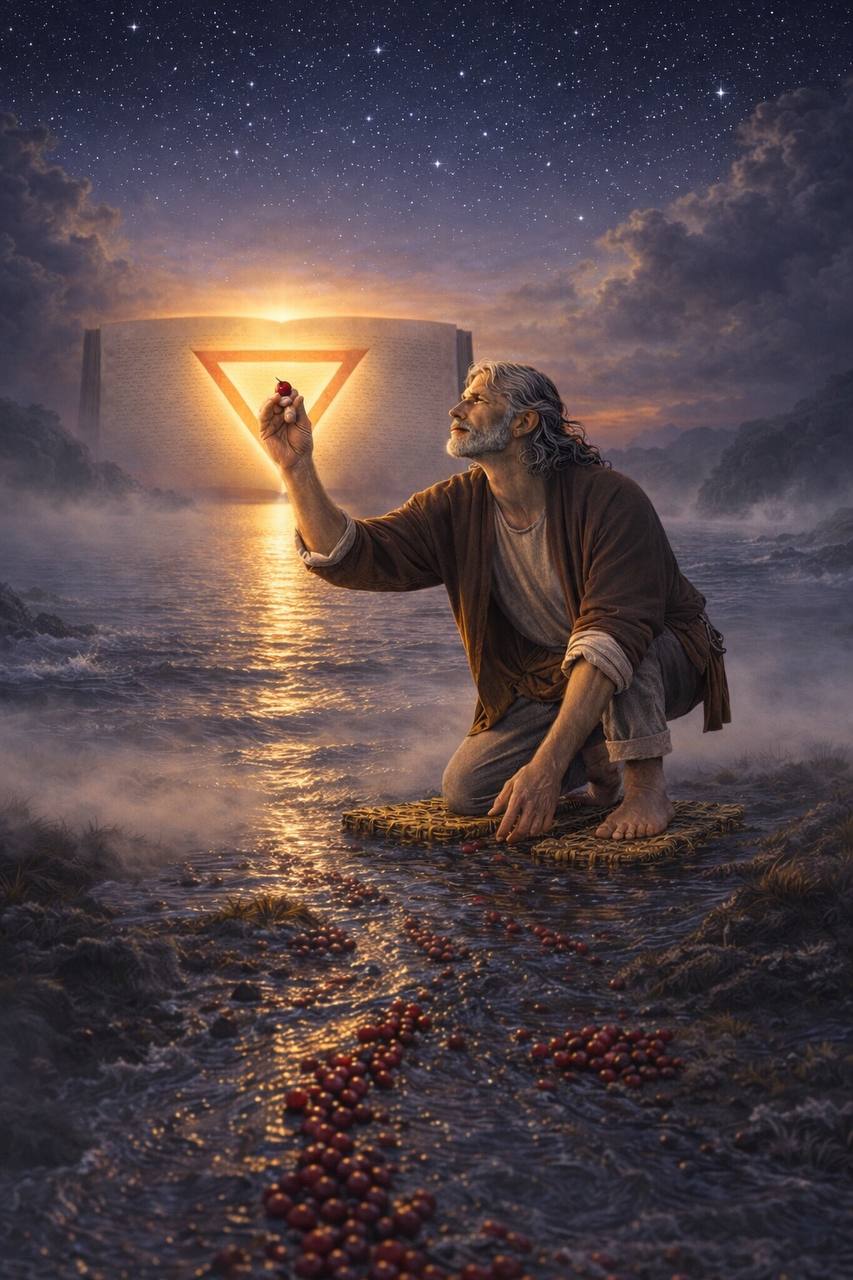
The great mysteries of the world are never revealed to those whose attention is insufficient for a decoding that unfolds through several stages.
Thus, the first stage will require from me a process of proof showing that, under the Spanish phrase:
“cuarta vigilia de la noche”
the Author of the Bible meant the berry-like fruit known to the world as cranberry.
All three words, through the mind-forms of which they are composed, point to cranberry.
The cranberry fruit is precisely what can be seen as a cuarta when it is cut in half.
The cranberry has a rather unique internal structure consisting of four clearly symmetrical chambers. These air-filled chambers allow the fruit to float on the surface of the water.
We shall now examine very carefully why our cuarta is also a vigilia.
The inner meaning of this word has nothing to do with wakefulness. It can only be fully understood by considering the meaning of each Egyptian hieroglyph and imagining how this word would have been written through Egyptian hieroglyphs.
For the moment, however, in order to demonstrate why the cranberry may rightly be called a vigilia, we must identify the common meaning shared by all words that would be written with the hieroglyphic sequence VG. The vowel I between the principal sounds merely serves as a vocalization.
I will therefore select words built upon the mind-form VIG, so that we may clearly discern the true essence of this particular mind-form.
As you are about to see, the essence of the mind-form VG is the act of pushing space apart.
Recall the phrase, “wiggle your way through.” Or consider wiggle worms: they bear this name because they push their way through the material surrounding them.
Likewise, the word vagina would also have been written with the hieroglyph VG. Its underlying essence is the same, for both during intercourse and during childbirth, the walls of the vagina are pushed apart to allow passage.
Now, to dispel the possible illusion that the phenomenon of a unified essence of mind-forms is confined to a single language—far from it. The sequence VG carries the same essential meaning in words across all languages.
Consider, for example, the Russian word podvigat', meaning to move objects in order to allow passage, or sdvig, meaning a displacement or a push-through movement. Both of these words would likewise have been written with the same VG hieroglyph.
Now imagine what happens to a cranberry fruit. Once the berry separates from the plant, it rises to the surface of the water. In doing so, it pushes aside the neighboring berries that are already floating, and by pushing them apart, it reaches the surface itself.
It is because of this final act of pushing space apart immediately before surfacing that the author of the Bible secretly chose to designate the cranberry by the word vigilia, written with the hieroglyph VG.
Now, as for the word night, please keep in mind the fundamental principles for understanding words that were established at the very beginning of the Book of Genesis.
God called the darkness Night. In this sense, one may discern the word DAR (gift) + K + NESS (bring). Yes, this English word is itself constructed through Russian.
Even more important, however, is the Russian word t'ma. Although it is translated as darkness, it also carries a second meaning: a multitude.
This double meaning was intended from the very beginning for the purpose of deciphering the Bible. Thus, whenever we examine the Bible on the sacred level, the word night means a multitude.
Now let us see what the author of the Bible intended us to one day perceive through his wording. In essence, the statement follows that God called the gathering together of the waters Earth because what the waters had carried and gathered into one place became the dry land.
Have you ever seen how the waters of countless little streams carry detached cranberries and gather them together in one place? Incidentally, cranberries possess a remarkable physical characteristic: they are always dry to the touch. This fits the Russian Bible perfectly, because the Russian word susha primarily means something that is not wet, while only its secondary meaning is dry land.
Moreover, elsewhere in the Bible the Promised Land signifies sacred knowledge, while the cranberries represent its individual fragments. I shall explain this in greater detail later.
For the moment, I need only complete the main thought: cranberries gather together in what the Russian language calls t'ma—an immense multitude—which, as I have already shown, is expressed in the Bible by the word night.
I believe you are beginning to understand what is emerging from our immersion into the phrase that is superficially understood as the miracle of Jesus walking upon the sea. In reality, Jesus is gathering cranberries.
And here we arrive at the next stage of understanding. The cranberry itself possesses no magical power. The key is to recognize that every single berry is a clue. This is hinted at even by the Russian word klukva (cranberry).
Once again, you have before you an example of a Russian word whose deeper meaning is revealed through its phonetic correspondence with an English word:
Klukva — Clue.
Now that we have clearly discerned the cranberry itself through the veil of the surface meaning of the Spanish words, I ask you to notice one more important word at the very beginning: Mas—for the phrase is precisely Mas a la cuarta vigilia de la noche.
The mind-form MAS will be revealed in its fullness only at the end of this book. For now, simply note that MAS is the principal image within the word Mactery.
One important detail concerning the gathering of cranberries—one that not everyone today is likely to know—is that cranberries grow in bogs. To harvest them, one literally has to walk upon the surface of the water. In order not to sink into the bog, people wear special wide platforms attached to their feet.
You will, of course, point to the Spanish expression sobre el mar, which is commonly understood as walking upon the sea, and ask how this expression fits the deeper understanding that Jesus was, in reality, collecting truth, one clue after another.
The answer is that the Spanish word sobre ("walking upon") is not accidentally phonetically related to the Russian word sobirat', meaning to pick up. Likewise, within the language of the Bible, the sea represents truth.
Recall the well-known Latin phrase memento mori, which, in this reading, becomes moment of truth, while mori echoes the Russian word more ("sea"), just as sea echoes the English verb see.
The secret of the Vatican—the Holy See—is truth.
Thus, the final two words, sobre el mar, conceal the decipherment: collecting the truth.
But what about the remaining Spanish words?
Jesús vino — Jesus came.
a ellos — to them.
andando — walking.
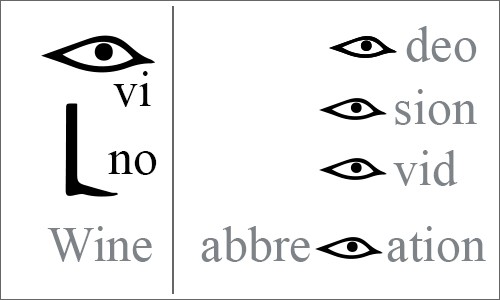
The word vino must be viewed through Egyptian hieroglyphs. It would be written with the hieroglyphs VI and NO.
The hieroglyph VI is represented by the eye, and words written with this hieroglyph are always associated with seeing. The hieroglyph NO, on the other hand, is represented by the foot, whose underlying essence is essence itself.
Why do you think Jesus kissed feet? It is because, in the language of the Bible, feet symbolize essence. Therefore, the Spanish word vino conveys the idea of seeing the essence.
It is always important to place yourself in the position of the creator of the Bible and of the languages themselves. There is a deeper knowledge and a sacred meaning to which the surface narrative must be fitted, and likewise the beautiful surface narrative must not, by a single word, contradict the secret meaning concealed within it.
Naturally, conveying the hidden meaning while simultaneously communicating the meaning of the surface story through the very same sentence requires a different number of words. This is why certain words appear to be unnecessary, while in reality they serve to complete the hidden meaning.
Ellos is not accidentally phonetically related to the Russian word el, meaning ate. Thus, at the deeper level, the word ellos indicates that what Jesus is gathering is something edible.
The word andando was intentionally made phonetically reminiscent of the English word undone.
Notice what happens to the cranberry fruit. Once the plant becomes submerged, the berry itself becomes undone—that is, detached from the plant.
Allow me to give voice to the thought that may already be forming in your mind.
Jesus did not walk upon the water—that much was already evident.
But the true miracle is something else entirely: Hieronymus Bosch's ability to know the future. This is but a small part of a far greater, demonstrable miracle capable of restoring genuine faith.
Quite a detour, wasn’t it?
But there was no other way to begin. I first had to prepare you for a deeper perception of the biblical concepts associated with water—including, as you are about to discover, the very word Vatican itself.
Andrei Bannikov. “Introduction.” Praeludium for Vatican. Digital First Edition. 2026. https://praeludium-book.com/chapters/introduction.html