The First Glimpse
At first it won’t be understood, ones grasped it will change everything.
The greatest challenge is to awaken a reader’s curiosity from the very first page. Therefore, I will begin by offering you an experience comparable to that of a person born blind, in the very first moment they begin to see.
The kind of sight I am speaking of, however, is not sight in its ordinary sense, but in its biblical one.
I want to show you how to begin seeing words.
And so that you may immediately glimpse what will happen when humanity regains its ability to see words, I will begin by revealing the hidden meaning behind something every student of the Bible has long accepted as nothing more than the ordinary number forty.
Deuteronomy 8:2 (KJV)“And thou shalt remember all the way which the LORD thy God led thee these forty years in the wilderness, to humble thee, and to prove thee, to know what was in thine heart, whether thou wouldest keep his commandments, or no.”
The semantic structure concealed within the number forty has nothing to do with counting. Instead, it is directly related to the ability to see words.
I will demonstrate this by beginning with the word forty itself. For comparison, I will also use the same word from the Russian Bible, where сорок likewise means forty.
Now notice that nearly every word which, in my system, would be written with the hieroglyph pronounced FO is connected with visual perception.
Would you agree that all of these words are united by a common underlying idea?
I hope so.
That common idea is precisely the meaning carried by the hieroglyph FO. In the biblical system of hieroglyphic writing, the word forty itself would be written with this very hieroglyph.
You might object by pointing to a word such as fork, which also begins with FO yet appears unrelated to vision. In my system, however, the word fork is determined not by FO, but by the hieroglyph FR; the vowel O merely serves as a vocalization between the two consonantal elements.
Forgive me for postponing the full explanation. My purpose at this stage is to awaken your curiosity, not to overwhelm you with theory. For now, I invite you to continue with a demonstration. The theoretical foundation will come later.
Now let us look at the Russian word for forty — сорок (sorok).
The first step is to perceive this word not as a sequence of letters, but as a structure composed of two semantic components:
Once a Russian speaker is invited to see this semantic matrix, the hidden construction becomes surprisingly transparent.
SOR means dust, debris, or small particles that obstruct proper function. The component OK represents an ancient form related to the eyes.
Thus, SOR + OK literally describes eyes filled with debris—eyes that cannot see because they are obstructed.
If I now write this same word using Egyptian hieroglyphs and explain the semantic meaning of each hieroglyph through hundreds of words drawn from many different languages, this matrix will reveal itself with even greater precision.
The moment we understand the meaning concealed by the biblical number forty, the familiar question, "How long did the people of Moses wander in the wilderness?", acquires an entirely different meaning.
The wilderness is no longer merely a geographical place. It is the condition of humanity itself. Humanity will continue to wander through the biblical wilderness until the Bible is deciphered—until the eyes of the human mind have been cleansed, allowing humanity once again to perceive the matrix of thought-forms from which all words are constructed.
You may now believe that, after learning the title of this book implies that Vatican is itself a book, there is nothing more to be discovered in the name Praeludium ad Vaticanum.
But what if, instead of merely reading the title, you were to actually see it?
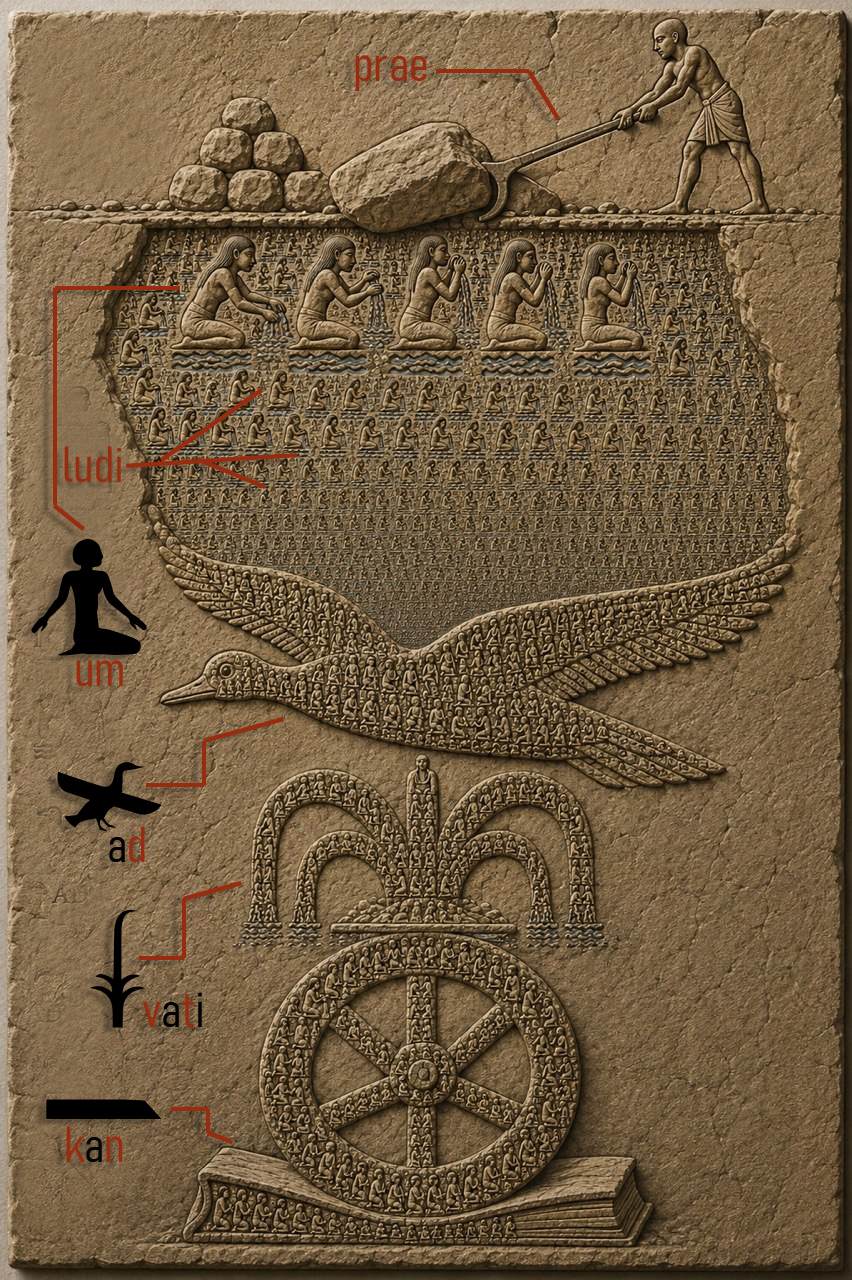
As you look at the sketch, you have probably already begun to recognize several of its meanings for yourself.
For example, you are familiar with the action expressed by the English verb to pry—the very action performed with a pry bar. In the sketch, I deliberately depict an Egyptian figure prying away a stone that conceals what lies beneath it.
Beneath that stone appears the element LUDI—a Russian word meaning human beings in the plural.
The final element, UM, is another Russian word meaning mind.
Thus, the Latin word Praeludium contains one English word and two Russian words:
Prying the Mind of Humanity.
This is the matrix of thought-forms concealed within the word Praeludium.
As for the sketch itself, I intentionally designed it to resemble a traditional Egyptian hieroglyph. The hieroglyph UM is represented by a human figure washing himself. In Russian, however, this action carries a remarkable double meaning. The verb umytsya literally means to wash one's face, but it also implies coming to one's senses, awakening to clarity of mind, and becoming mentally aware.
That is why I depicted not one person, but many people performing this very act. The image symbolizes not merely physical cleansing, but the awakening and cleansing of the Mind of Humanity.
I imagine that by now you expect me to quickly reveal the deepest meaning of the most significant term in the lexicon of sacred knowledge—the very term chosen as the name of the most influential state in the world—and that this revelation will astonish you so profoundly that you will leave these pages unable to think of anything else.
No.
Perhaps books were written that way some time ago. But the world has changed, and I can no longer address people without giving them clear signals.
Therefore, we shall indeed approach the mystery of the word Vatican, but I invite you to take a rather unexpected path toward it.
Andrei Bannikov. “Introduction.” Praeludium for Vatican. Digital First Edition. 2026. https://praeludium-book.com/chapters/introduction.html