Glass of Water
How Nilebann Sells a Glass of Water as an NFT for 6 ETH
I know with absolute certainty that the discovery I am striving to bring into the world is of biblical magnitude, and that humanity needs it now more than ever.
After countless attempts to make the world aware of it, I have also learned how difficult it is to reach those who hold the keys to a large audience. It is not that my knocking has gone unheard. Rather, people are driven primarily by their own interests.
“Why do you keep bothering us with your hieroglyphs?”
“Who was that?”
“Just some eccentric claiming he's the first person to have actually read the Egyptian texts.”
“But what if he's right?”
“So what? I have nothing I can buy from him and sell for a profit.”
Years passed.
I invested heavily in advertising something that was not even a product, and repeatedly tried to draw the attention of influential people—those who might have understood its importance, yet were simply too busy to devote themselves to something this profound.
So now I say it openly.
I am going to sell you something genuinely valuable.
And that fact alone will compel you to look deeper and deeper until, one day, you finally realize what it is that you have actually purchased.
When that moment comes, I am certain you will find a place worthy of displaying it.
Curiously enough, among people of a certain status—the very people I spent years trying to reach—the same idea seems to circulate again and again:
“One day, someone will appear who can actually sell us a glass of water.”
I am sure you have seen those famous job interviews where the candidate is asked:
“Sell me this glass of water in six seconds.”
And I thought...
Six seconds is far too cheap.
It should be sold for at least six ETH.
Because time equals money.
As you may have guessed, I am not applying for a job.
I am simply offering to sell you a glass of water as an NFT—provided your means allow it.
There is only one condition.
The water will be the very same water that Jesus turned into wine.
No, I am not joking.
The water I am offering is precisely what the Bible calls “water.”
Now, if after reading the previous chapter you are still convinced that Jesus literally walked upon H₂O, then what follows is probably not meant for you.
The Bible says that the gathering together of the waters results in the appearance of the dry land, which God called Earth.
If that is true, then the biblical word water cannot simply mean ordinary water. It must refer to something entirely different.
After the previous chapter, we can already picture the waters carrying cranberries until they finally come to rest in one place, where the current comes to an end.
And if every single berry is a clue—an individual discovery—then all such clues, gathered together, become a single body of knowledge. It is this that God called Earth. It is this that is the Promised Land.
Although this is not quite the right place to discuss it, since every revelation must first be supported by a properly constructed body of evidence, now that we have encountered the word land, I should explain that, according to the composition of its mind-forms, this word is connected with landing—the completion of a fall.
Thus, the biblical land is the place where the spiritual fall of the fallen angels comes to an end. It is also where the spiritual fall of human beings, who have forgotten who they are, comes to an end.
Let us return to the biblical water and construct a kind of conceptual equation. Just as ordinary water carries cranberries, biblical water gathers all the clues into one place. And those clues, gathered together, become sacred knowledge.
So what, then, is the biblical water?
In biblical text, water is that which leads a human being.
The idea is remarkably simple.
If biblical water is that which moves both an individual life and the course of humanity itself, then water is the greatest motivator imaginable.
And motivators are always expensive.
For one simple reason.
There will always be someone more motivated—someone with greater resources—who is willing to pay more for what others already consider valuable.
“So then,” you may ask,
“What exactly does the Bible mean by water?”
Then allow me to answer in the only appropriate way.
“May I pour you a glass?”
Nothing guides a human being more powerfully than the desire to know what others do not know.
That is biblical water.
It is no coincidence that the Spanish word agua and the English word acquire resonate both phonetically and conceptually within the linguistic system presented in this book.
Through such resonances, a human being becomes capable of reaching what remains inaccessible to everyone else.
So...
May I pour you a glass of that water?
In the form of an NFT.
If a live dialogue were happening right now between you and me — you, my buyer of a “glass of water” — you would ask:
“If water is not H₂O, but something that, when gathered, becomes dry land which God called Earth; if Jesus walked upon this ‘water’ and turned that same ‘water’ into wine — how is this structural-linguistic riddle to be solved?”
It is precisely here that we arrive at the moment when you open MetaMask and become the owner of an NFT-formulation of knowledge that others do not possess.
I propose that we grasp the logic of the Author of the Bible and the Author of the global language system.
Languages are constructed so that entry into hidden meaning is found not through translations, but through resonances of sound and sense.
The Russian voda — water and the Russian vedenie — guidance / leading — resonate conceptually.
To enter, one simple thing must be understood: biblical water leads.
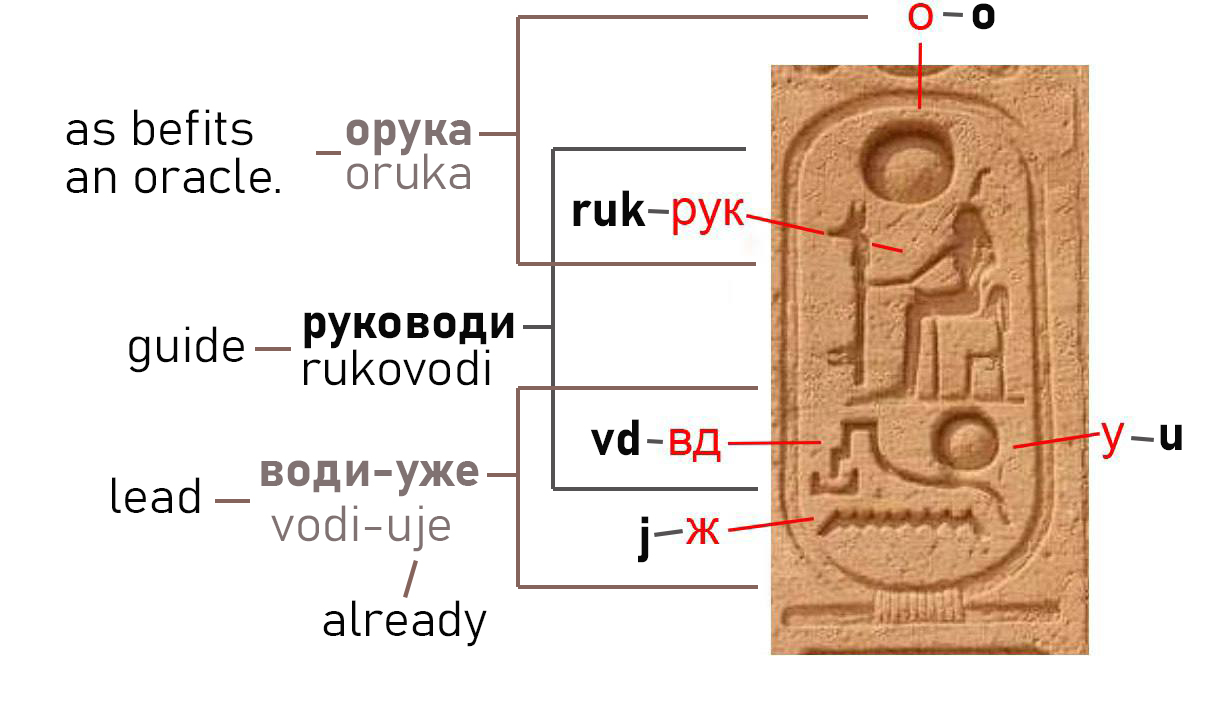
Two possible readings of the cartouche come together into a single semantic matrix:
“O, guide already” + “Oruka, lead already” = O — ruka — vodi — uzhe
Here it is important to understand the word oruka—as befits an oracle.
Soon you will discover the true semantic and poetic nature of the cartouches.
Yes, they are poetry—poetry composed of mind-forms, assembled into a brilliant rhyme through a collective word that is always an adverb, a form of speech that answers the question how.
How? — O-RUKO-VODI-UGE
As you have already seen from the reliable translation presented in the image, a single word contains an extraordinarily rich semantic structure.
For the moment, however, I am showing you this cartouche for a different reason—to introduce you to the hieroglyph VD.
This hieroglyph, by itself, can be read as the Russian word voda, meaning water. Yet the true essence of this hieroglyph is leading.
Look carefully at the image itself.
Imagine that you need to transfer water from a reservoir in such a way that the pipe first rises to a point higher than the surface of the water in the reservoir, and only then descends below that same level.
The moment the pipe is completely filled with water, the water begins to flow upward by itself.
Further, the Bible states: the gathering of the waters became dry land.
The riddle is simple.
The gathering of waters is the gathering of writings — source books in which that is contained which has led humanity through centuries along a spiritual path. And “land” here does not mean territory, but hidden knowledge — that which was unknown.
Jesus turned the water that leads into wine. Remember the hieroglyphs from the previous chapter: the eye — VI, and the foot — NO.
The word wine, when seen through the imagery of Egyptian hieroglyphs, does not signify a drink, but rather a carrier of knowledge in visual form.
Consider the Latin word Praeludium. As long as it is merely understood as a word meaning prelude, it is biblical water.
But once we perceive it as prae (to pry open) + ludi (humanity) + um (mind), the word we have now seen becomes that very water transformed into biblical wine.
Once again, there was no literal miracle of turning water into wine. And, to be honest, no one truly believed in such a miracle anyway.
But consider this: if every word of every language was created so that it could be transformed from water into wine, and then back from wine into water, would the creation of such a design not require nothing less than a Higher Consciousness?
Now imagine the true value of a glass of biblical water which, when poured upon biblical dry land, transforms the biblical desert — through which humanity has wandered for forty years — into the Promised Land, into open knowledge.
John 1:23 (KJV)He said, I am the voice of one crying in the wilderness, Make straight the way of the Lord, as said the prophet Esaias.
I have turned this glass into a real object of contemporary art and documented it as an NFT under a title that is a biblical definition written in Russian:
Glass vopiushego v puctyne.
Translation - “A voice crying out in the wilderness.”
— Incorrect!!! (but this was intentionally designed)
And this is why:
Everyone reading this line in Russian assumes that the word glass here is a stylized form of the Russian word golos (voice).
But it is deliberately the English word glass placed into the text.
And “the one crying” is not someone who weeps, but the one who drinks from this glass in the desert — the one who has finally reached the Promised Land, that is, knowledge.
The word vopiushiy in the Russian biblical text was considered closest to the verb vopit’ — “to cry out in pain.”
But there is another phonetically close word, resonant with vopiushiy: pit’ — to drink.
Without understanding that the word glass in the Russian biblical text is actually an English word, no one ever even considered this possibility.
At this point, English-speaking readers often begin to argue that the Old Testament was written in Hebrew and the New Testament in Greek. I sincerely pity such disputants.
They are usually intelligent people who hang paintings over their safes at home — yet they believe that the ancient author of the source texts possessed the resources and knowledge to build pyramids, but lacked the cunning to lead the unworthy down a false path.
Now I will describe my NFT by explaining its essence and details.
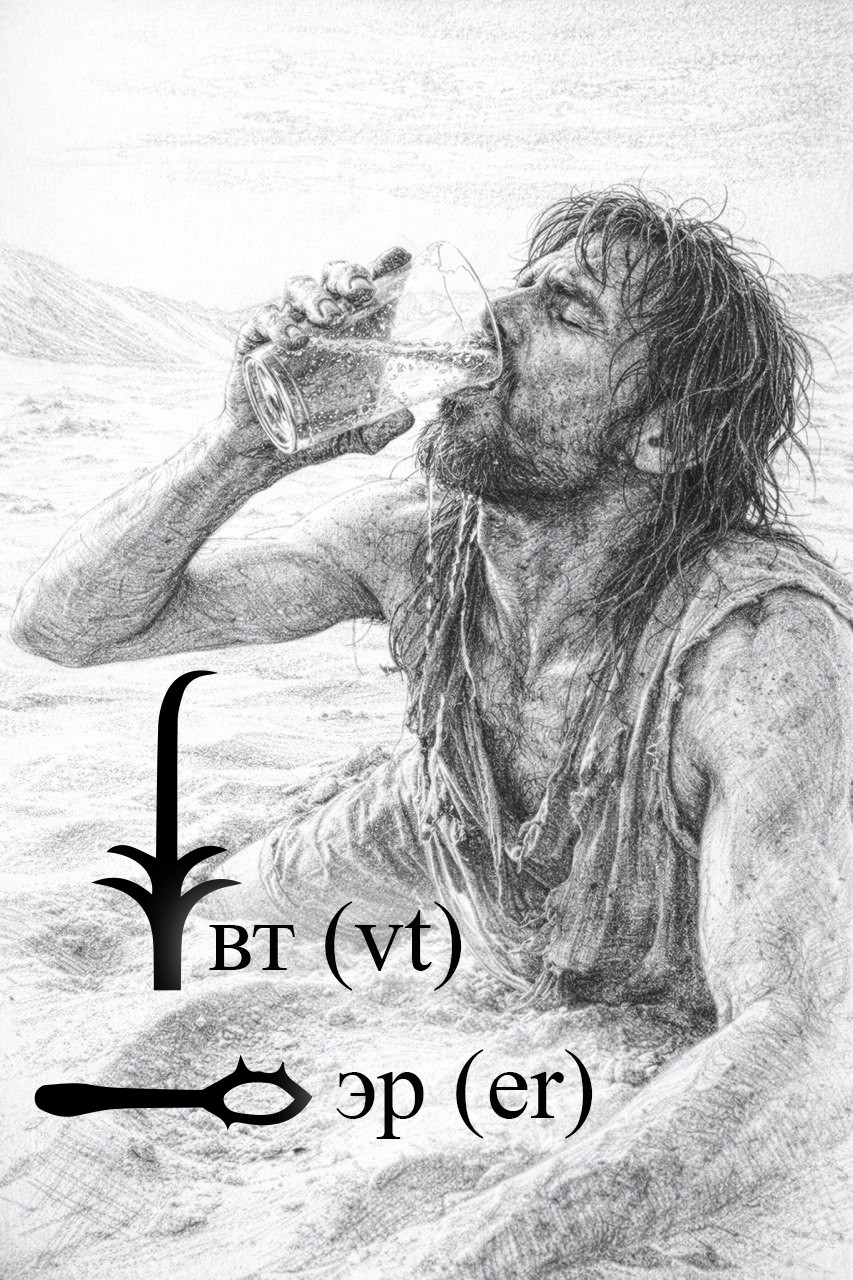
At the center of the image is a traveler in the desert drinking water from a glass. This captures the correctly understood biblical phrase that was entirely mistranslated into English:
“A voice crying out in the wilderness.”
In the source text, the word used was Glass — not “voice,” but a glass.
Biblical water is that which leads to the revelation of knowledge, to an exit from the spiritual desert.
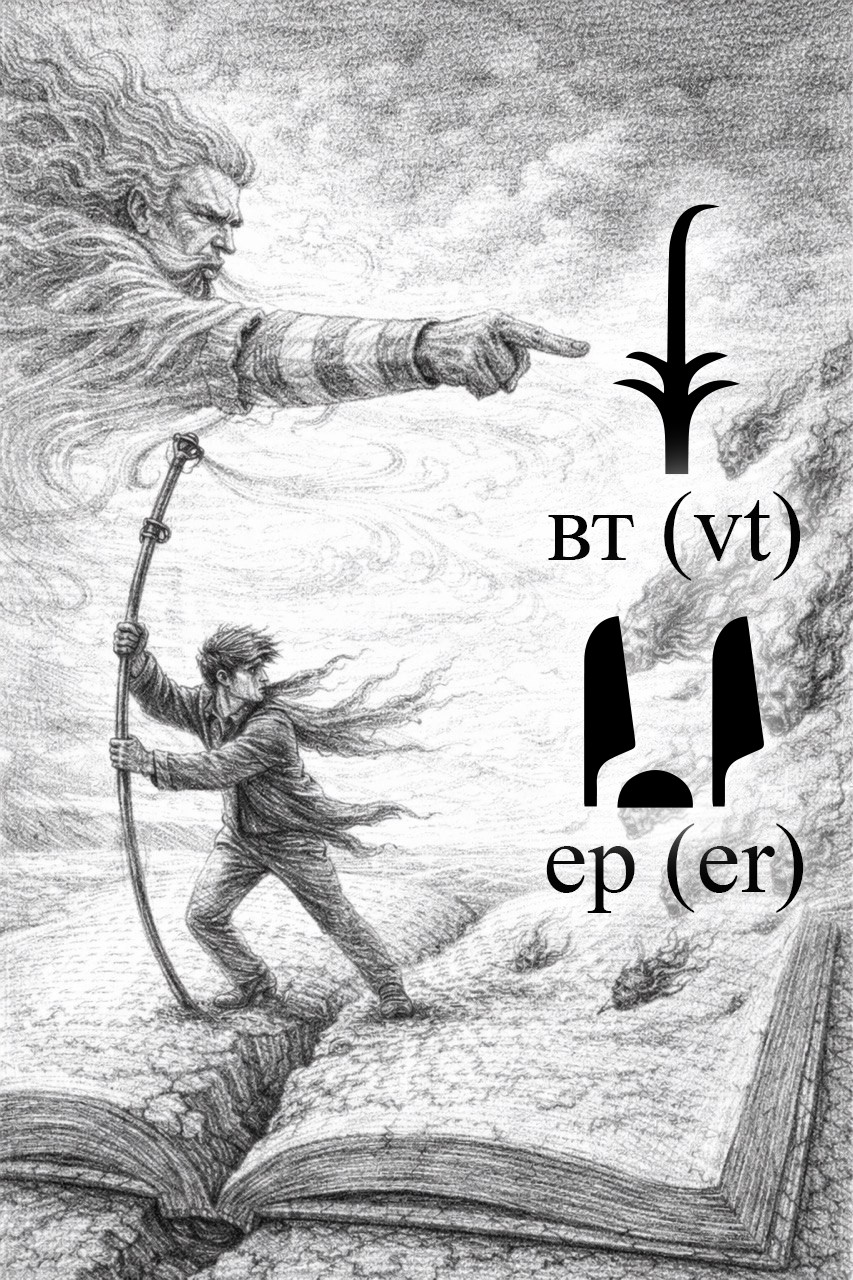
In this part of the image, I inscribe the English word water as it would be written in ancient Egyptian hieroglyphs: the hieroglyph VT and the hieroglyph ER — water.
Looking ahead, I will clarify: in this NFT image, only words containing the hieroglyph VT are visually represented. This hieroglyph depicts a geyser or fountain, with jets indicating direction. On the surface it means fountain = water. On a deeper level, VT corresponds to the Russian word VOT — an indication, a pointing, a leading.
Next, I add the Russian word VOT, written as a single hieroglyph VT. It appears as an old desert signpost — a board shaped like an arrow pointing toward a well.
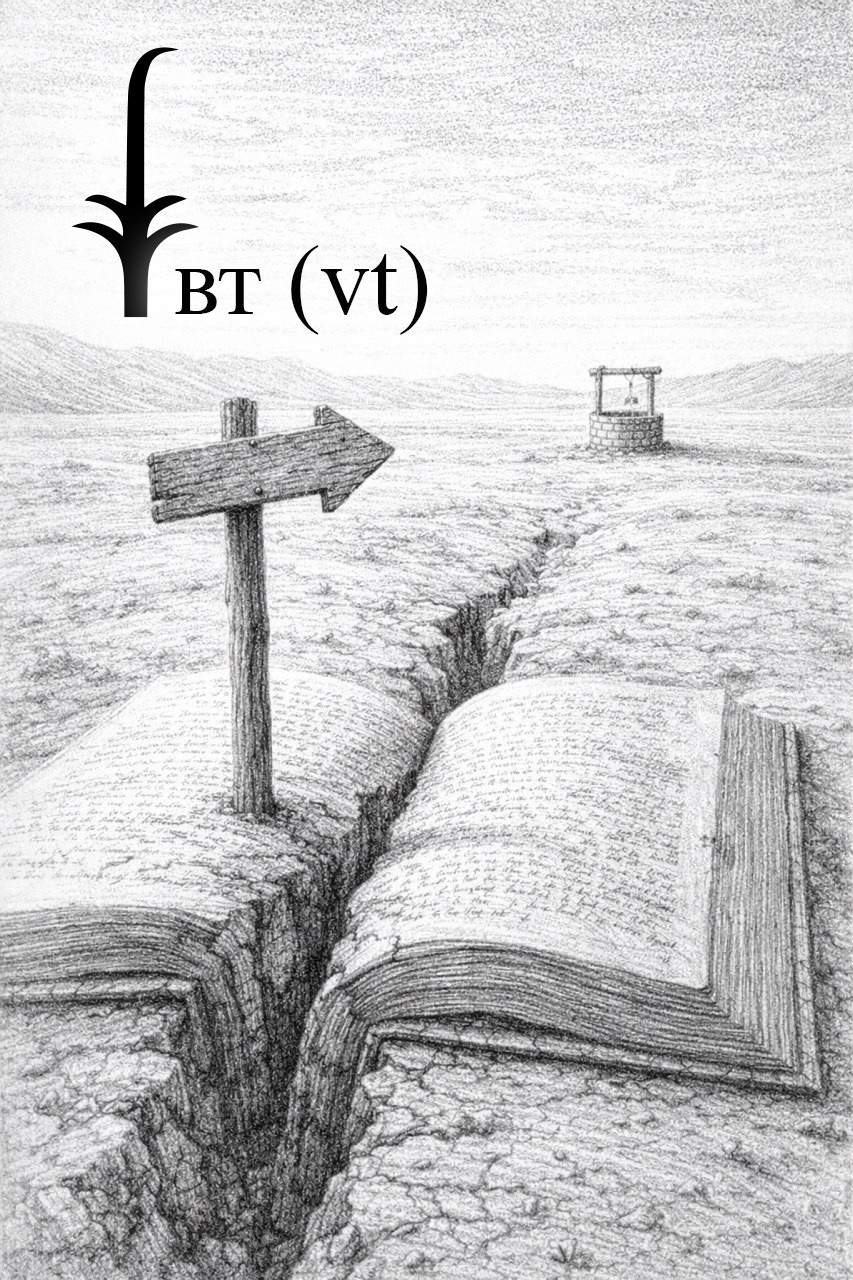
You have likely already realized that the Russian vot and the English water are constructed as interconnected elements of a single design for biblical revelation.
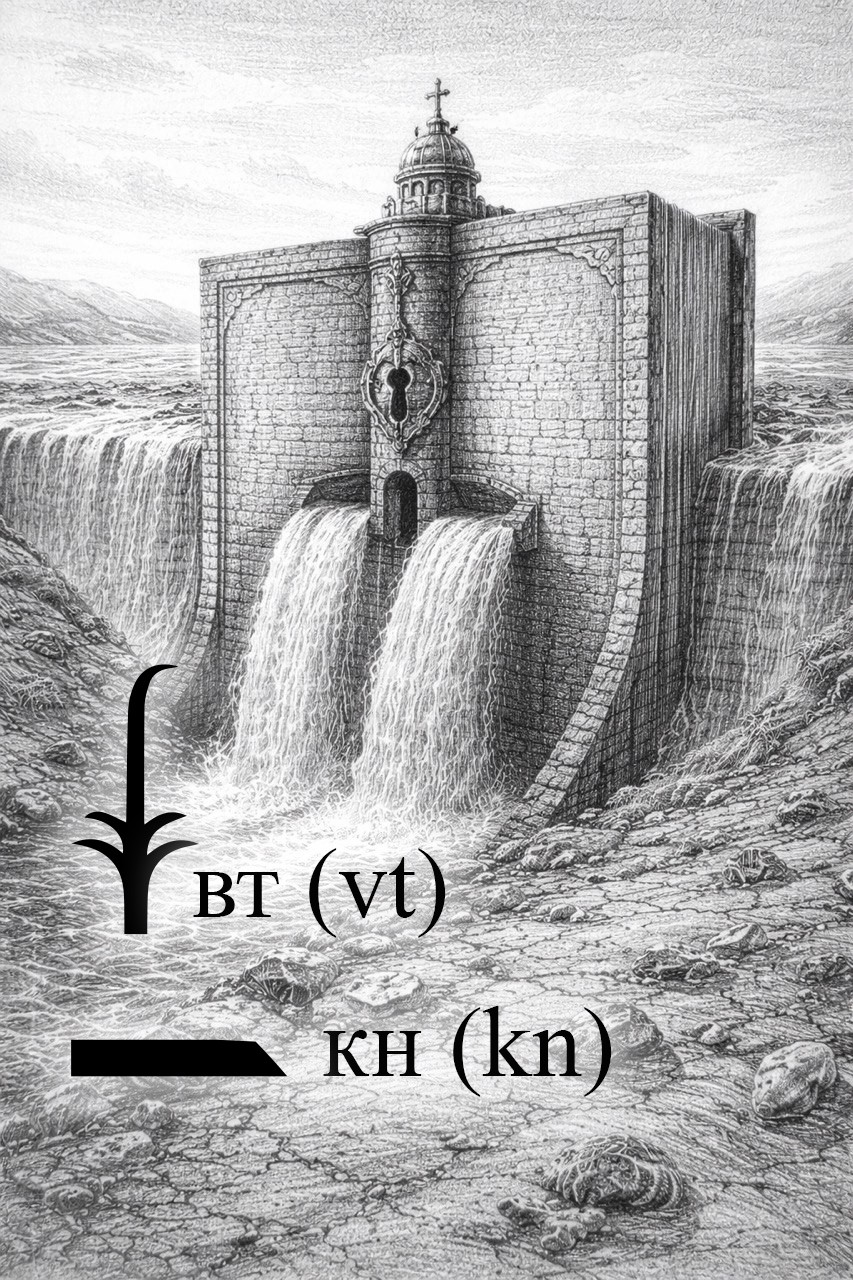
Finally, I depict the word Vatican:
VT — the same fountain hieroglyph, and KN — kniga (book).
A book of many books, a collection of texts composed of encoded biblical water. This is the “gathering of waters” that the Bible names as dry land.
Through the imagery of speech, biblical water VT and book KN together yield the name — VATICAN.
I also reveal the word wind.
The Russian word veter would likewise be written using the hieroglyph VT, whose essence is leading. After all, veter — wind — leads by its direction; it guides movement through itself.
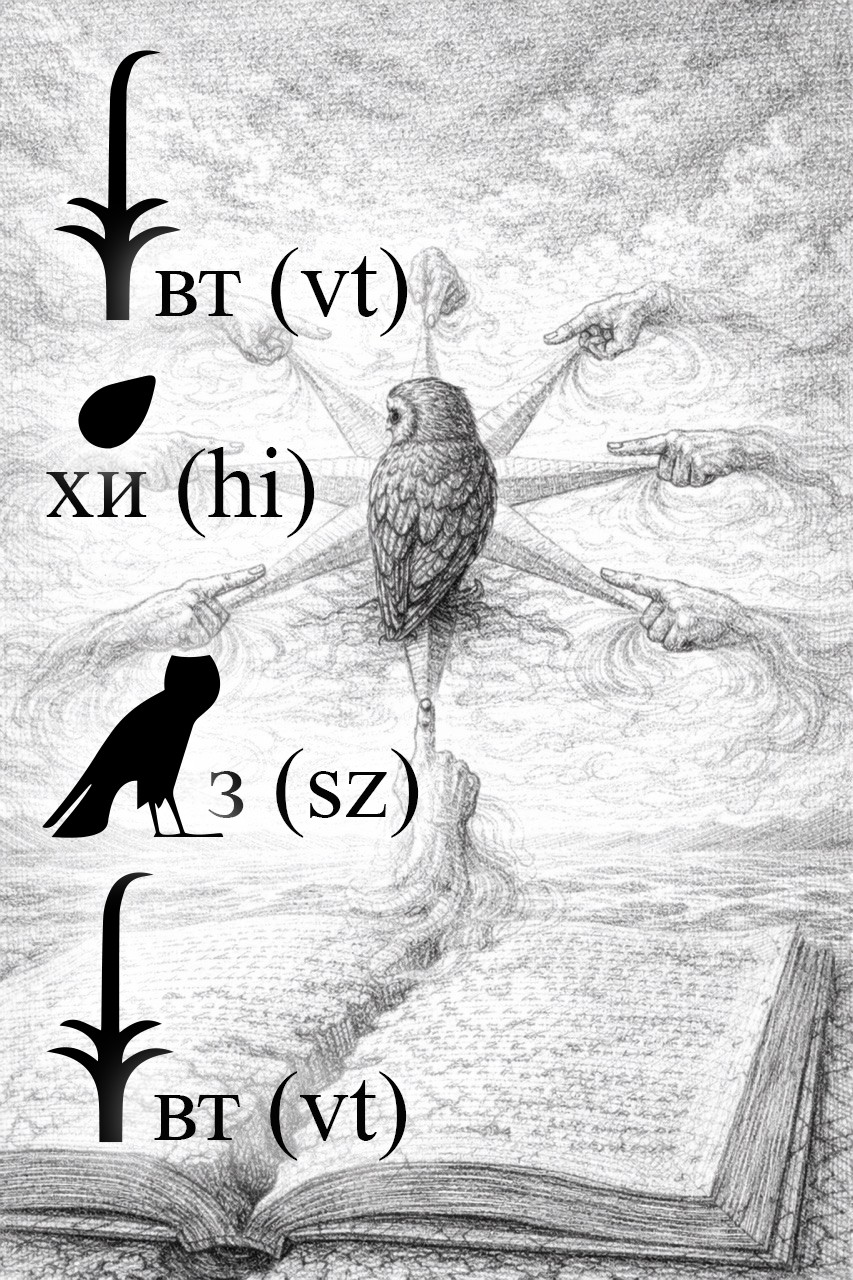
I also depict the Russian name of the Torah — Vethiy Zavet (the Old Testament).
This title contains the hieroglyph VT twice. When written in hieroglyphs and understood through the essence of each sign — an essence you have already grasped on both a surface and a deeper level through this NFT — it becomes clear that in all words, across all languages, VT carries the same core meaning: biblical water, the principle of guidance toward awareness.
Vethiy Zavet (Old Testament) is a rose of spiritual winds, guiding souls along the spiritual path.
At first glance, it may seem that the thought-form VT has now become clear and fully grasped.
It has not.
The journey toward its realization is not yet complete—we have merely touched upon an intermediate meaning.
Notice that I have now selected another group of words in which I have already replaced VT with its corresponding hieroglyph.
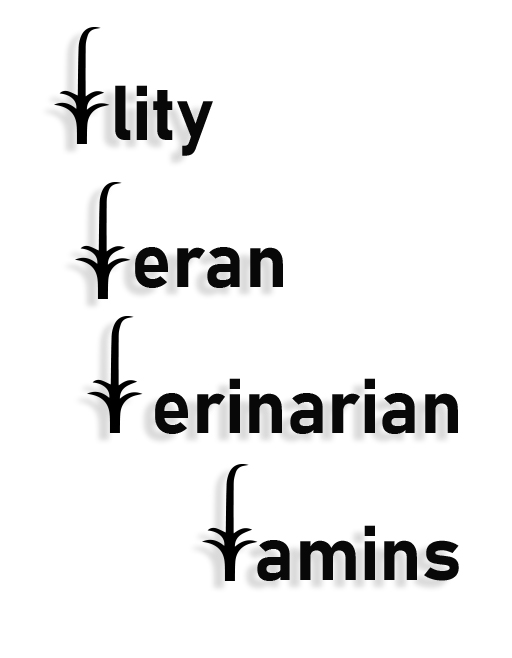
Vitality · Veteran · Veterinarian · Vitamins
The VT hieroglyph is present in every one of these words, yet the idea of direction no longer appears to be obvious.
As I explained at the beginning of this book, the essence of an elementary mind-form cannot be defined through the meaning of any single word. At best, one may choose a supporting word whose meaning helps illuminate the thought-form and makes the path toward its realization easier.
The words vitality, veteran, veterinarian, and vitamins, however, clearly share something in common: they all relate to the process of life.
A veteran survived.
A veterinarian helps an animal survive.
Vitamins and vitality are directly associated with the sustaining force of life.
This naturally raises an important question:
How, then, are these words connected to the idea of direction?
Think about it for yourself.
Is not vitality itself the consequence of choosing one direction over another?
One person chooses the path of health. He avoids destructive habits, disciplines himself, and strives to remain in good physical condition.
Another chooses the pursuit of immediate pleasures, gradually undermining his own health.
The word veteran, through the thought-form VT, points precisely to the vitality of someone who chose the path that ultimately brought him back from war alive.
Now let us return to the words we examined earlier:
veter (wind), water, and svet (light).
Without wind, without water, and without light, life as we know it cannot exist.
Thus, the VT thought-form within these words is also closely related to vitality.
Consider this carefully.
Vitality is, above all, the continual choice of a particular path through life. Every decision shapes a new direction, and those directions ultimately determine whether life is strengthened or diminished.
In this sense, direction and vitality are inseparable.
And now you have seen and felt the connection between all the words united by the image of VT. In truth, this is the first drop of genuine biblical water you have ever experienced.
In this article, I deliberately do not show what the described artwork looks like in physical form.
If I have sold you a glass of biblical water, then now you must go and seek the well from which I drew it.
You will follow a path that will eventually lead you back to me — but by walking your own path of searching, you will be ready to fully immerse yourself in this water.
We have come very close, yet I have still not fully revealed the mystery of the word Vatican. Throughout this book, we shall continue adding new layers of understanding, and in the end, I hope that epiphany will greet you with a warm embrace.
Andrei Bannikov. “Introduction.” Praeludium for Vatican. Digital First Edition. 2026. https://praeludium-book.com/chapters/introduction.html