The Drake of the Heavenly Pond
The Sad Story of a Peculiar Hieroglyph.
I think you have already guessed that every hieroglyph has its own degree of difficulty. Some of those shown in the previous chapter were derived without much effort and are therefore comparatively easy to explain. As a rule, these are the hieroglyphs represented in only a small number of words within the language.
Those that occur constantly, however, are far more difficult to derive. Yet once their sound has been identified, verifying the result is somewhat easier, because more texts containing them are available. I need only make certain that, with this hieroglyph in place, the text can still be read without losing its meaning.
And if anyone were to ask which of the hieroglyphs derived so far proved the most difficult at the time this book was written, I would answer without hesitation: the very last hieroglyph to find its home.
In the older version of the table of hieroglyphs—the very one that, by indirect means, I once managed to send to Pope Francis—the duck was not in its proper cell. I moved it only recently, and now you and I will examine together whether the most difficult hieroglyph found to date has finally been placed correctly.
Look at it impartially and consider the answer to the same question once again. The ancient author chose this particular image because it conveys a specific elementary and indivisible essence more clearly than any other image could.
Before the hieroglyph speaks — before I offer any clues — try to determine what that unique essence might be.
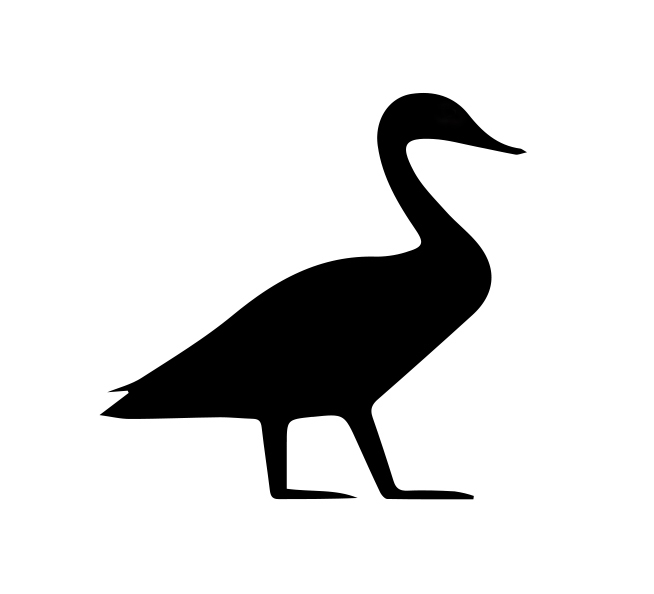
Thank you for taking the time to think about this question for yourself.
The duck hieroglyph is shown here in a neutral state—that is, without being associated with any particular action. Standard logic therefore suggests that the essence we are looking for should be sought in the biological species itself.
So, in this case, the question becomes:
What is the defining characteristic of ducks?
And once again, you have given it some thought.
Ants are unique in their collective organization: together they build entire underground cities with complex infrastructure. Beavers build dams, caterpillars transform into butterflies, parrots speak ten languages—but ducks?
Ducks are not really all that unique, are they?
Ducks possess no characteristic that belongs exclusively to ducks; other species of migratory waterfowl are, in general, quite similar. Believe me, I spent a very long time trying to discover something truly distinctive about a duck, knowing that no living creature is chosen to represent a mind-form as a hieroglyph without a reason.
And it was here, having seemingly exhausted every possibility, that I took my work down a path that was, with high probability, doomed to failure. I gathered several largely deciphered texts in which this particular hieroglyph remained in question and began substituting possible sounds, looking for one that would produce words in all of those texts at once.
After a long and essentially mechanical process, one sound finally matched, producing intelligible words in several texts simultaneously. But in the one text where neither the words nor the meaning would come together, instead of questioning that apparent success, I began to doubt the hieroglyphs surrounding it—and from there I wandered off in the wrong direction.
It was rather like realizing that you are already lost, yet trying to convince yourself that no mistake was ever made, and so you simply keep walking and walking in the wrong direction. In my case, I was mercilessly kicking hieroglyphs out of positions that had actually been correct all along.
In short, one accidental coincidence involving a single hieroglyph was enough to begin dismantling a system I had spent years building.
It was a lesson I would never forget.
Now, unfortunately, I must admit to something rather strange about myself. I say unfortunately because openly admitting that you remember something that never happened may easily be perceived as an anomaly of consciousness.
Throughout this book, you will encounter many biblical and Egyptian revelations, and I always accompany them with substantial supporting evidence. In fact, the greater part of my work consists precisely in searching for confirmation of what I already know. If the confirmation proves sufficiently convincing, only then does my publication enter the world: the revelation of an ancient mystery accompanied by arguments offered as evidence.
In this particular case, however, I am going to tell you something for which the only confirmation I have is the essence of our duck—a meaning that proved extraordinarily difficult to uncover.
So here it is.
About ten years ago, I searched through the entire Book of Revelation because I was absolutely certain that one of its chapters told of a drake from the pond of Paradise who had left that pond.
Imagine my surprise when I discovered that the chapter—which I remembered just as clearly as the other chapters of the book—was simply not there at all.
I later satisfied myself that nowhere in the entire Bible, nor in the apocryphal writings associated with it, is there any mention of a drake from the pond of Paradise.
Incidentally, on the very day when reality confronted me with this rather serious oddity, I began to sense, with a kind of inner certainty, that John the Baptist and John the Theologian were not two different individuals. Rather, the story of John the Baptist was a key accompanying legend, composed and introduced as a real history so that, one day, through it, the mystery of a chapter of John the Theologian might be revealed.
Yes, in English it is genuinely difficult to see where I am leading you. Russian makes the connection immediately accessible. The word obezglavlen can be understood in the ordinary sense of decapitated. But it can also be applied, quite literally, to the author of a book from which a chapter has suddenly been removed—as though he had never written it at all. Such an author, too, could be called obezglavlen, because the Russian word for chapter is glava, which also means head.
In fact, by its very construction, the Russian word obezglavlen seems almost more naturally suited to a writer whose glava has been removed from his book than to an actual execution.
Forgive me for taking your time with something for which I cannot offer supporting evidence—unless, perhaps, the following can be established.
The nonexistent chapter, like all of John’s chapters, carried a deeper meaning. And it was through grasping that deeper meaning that I eventually arrived at an idea which, rather than describing any further, would be better shown to you visually.
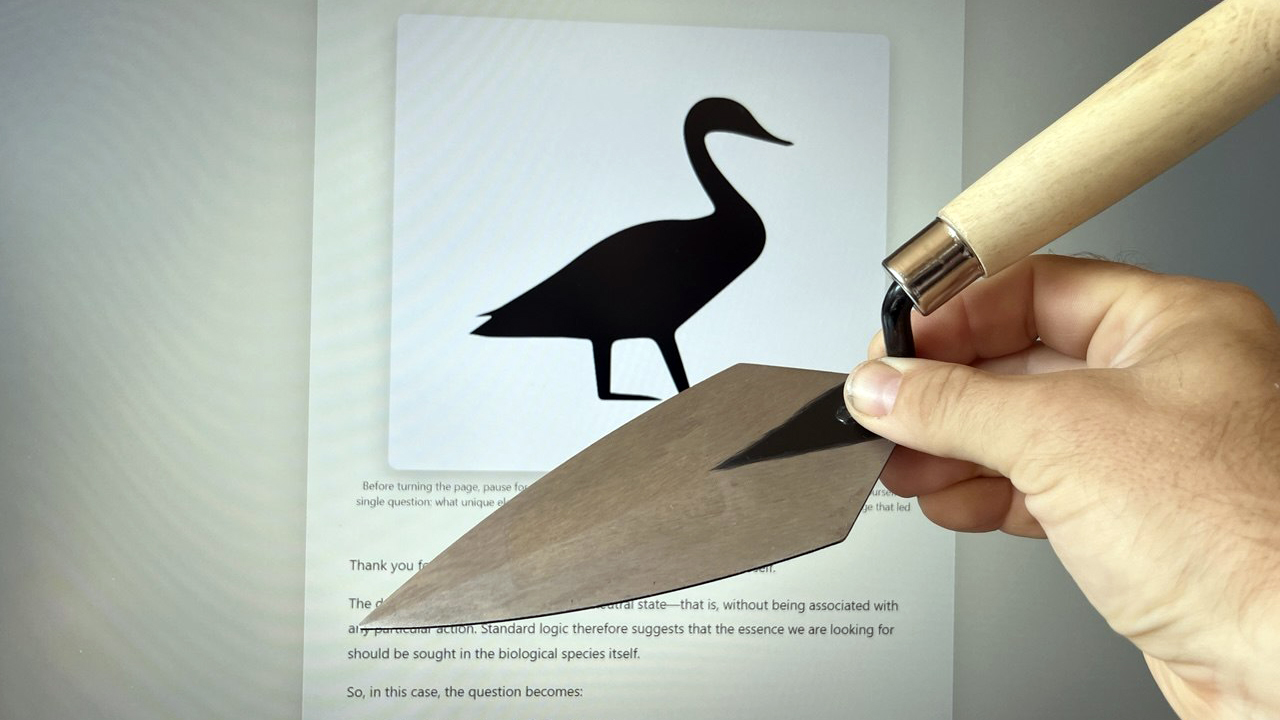
Looking at this image, do you see the resemblance between the two objects—the hieroglyph on the screen and the trowel I am holding in front of it?
Notice how:
the bird’s long body, widening toward one end, resembles the triangular blade of the trowel;
its narrow, raised neck appears almost exactly where the handle support of the trowel begins;
and, most interestingly, the resemblance becomes particularly striking when the trowel is viewed from this angle—its blade forming almost the same elongated, wedge-shaped silhouette.
Now think: can you name any other recognizable object whose overall silhouette matches this hieroglyph so closely?
So closely, in fact, that one might begin to wonder whether the hieroglyph is not really a duck at all, but a trowel deliberately depicted in such a way that everyone would initially mistake it for a duck.
And so, that nonexistent chapter, through its hidden meaning, revealed the mystery of the event called Christmas—the very word which, if represented in Egyptian hieroglyphs, ends with the hieroglyph of the trowel.
I had always known that the MS hieroglyph had to be the trowel of a master mason, and I kept searching through the texts for a hieroglyph that resembled a trowel. Yet I could never find one.
Then, quite recently, I found myself thinking once again about how strangely consciousness sometimes works, and once again I remembered that missing chapter. But this time, suddenly, came the realization of what the pond of Paradise actually is. The water within it is, of course, biblical water, while the pond itself implies a dam — and a cry in the wilderness.
At that very moment, everything fell into place.
And at that moment I knew that the Egyptian hieroglyph occupying the place of MAS in the word CHRISTMAS was none other than our "Duck".
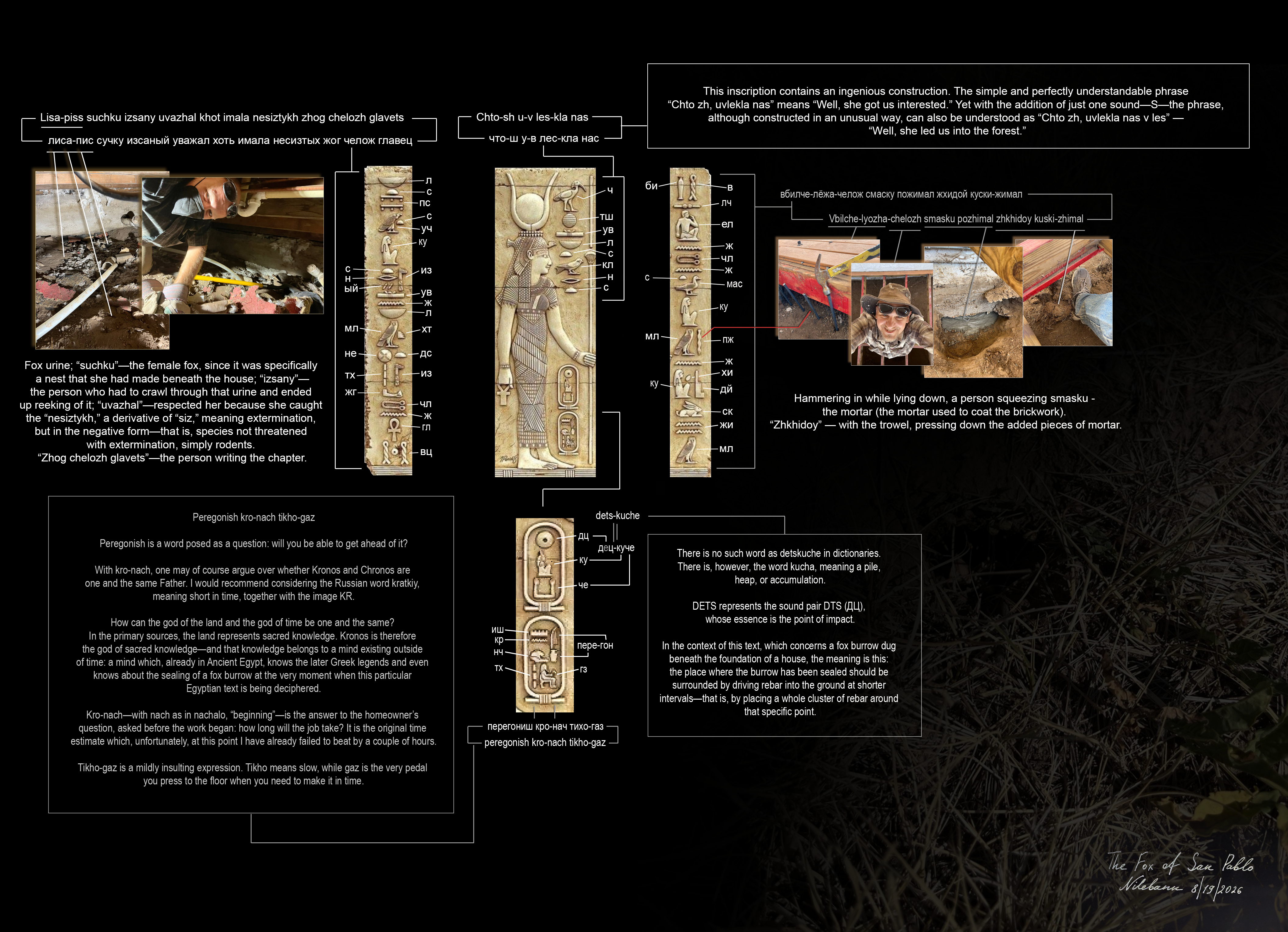
Have you seen the film Idiocracy?
Perhaps it is somewhat improper of me to point directly at the modern way in which new information tends to be perceived. But you, respected reader, are far from the first person to whom I have presented this material, and by now I am familiar with the prevailing tendency of perception—one that, unfortunately, appears to have been shaped by the evolutionary process itself.
No matter how I formulate or present the NFT shown above, a “normal” person by today’s standards will not wish to examine the document thoroughly. Instead, relying upon previous life experience, such a person will simply conclude that photographs from the repair of a burrow beneath the foundation of a house could not possibly have anything to do with an inscription carved upon the monuments of Ancient Egypt.
But if a person truly possesses a free and living mind, the approach to the document will be impartial.
The first thing such a person will do is verify whether the pronunciation assigned to every hieroglyph in this text corresponds to the Periodic Table of Egyptian Hieroglyphs that I have constructed. The same person will also verify that many other texts I have presented—including those appearing in this book—are read according to the same hieroglyphic values established in that table.
The next step is to hear the text itself.
If, while reading this book, the reader is uncertain whether the text is being pronounced correctly, the same book is available at praeludium-book.com, where every Egyptian text examined here is accompanied by audio of its reading.
Almost all Egyptian texts are written through a particular kind of rhyme known to the world as Bylina. Even without independently understanding the language in full, a thoughtful person will immediately recognize that the sound itself reveals an extraordinary harmony among its elements—a harmony corresponding, at the very least, to coherent and natural human speech.
Someone familiar with the subject will also immediately notice that this is nothing like the unpronounceable collection of sounds produced by official Egyptologists, who conceal the fact that, despite all their efforts, they have not actually managed to read what was written in Egypt. Consequently, everything written there becomes an endless list of names—and never mind that the names themselves turn out to be virtually unpronounceable.
Next, an attentive person will notice that the principal female figure has what appears to be the same image above her head as Hathor does. However, there is an important detail for us: where Hathor has antlers obscured by the solar disk, the woman in the relief has specifically fox ears, intended at first glance to resemble Hathor’s antlers.
“So the text really could concern a fox,” a person with a living mind might think.
And if that person is also completely fluent in Russian and English, another detail becomes apparent: laying brickwork into a hole beneath a foundation—and moreover beneath the joists of a partially dismantled patio—can indeed require working in an extremely uncomfortable lying position, exactly as stated in the text. The remaining nuances correspond just as precisely.
Now we come to what matters most for the line of reasoning I am developing.
In this text, the word smaska—putty is represented through the hieroglyph MS.
No, this is not accidental.
The hieroglyph is a duck whose form corresponds precisely to the silhouette of a trowel—the very tool used in carrying out the work described in the text.
A higher consciousness is capable of generating any detail required by the author—something that, from the human point of view, is perceived as absolute coincidence.
And now I will present other texts containing the same hieroglyph, so that you may judge for yourself whether this derivation is justified.
Цена (Russian: tsena) — price
Andrei Bannikov. “Introduction.” Praeludium for Vatican. Digital First Edition. 2026. https://praeludium-book.com/chapters/introduction.html