“John Sullivan, Are You There?”
The Living Practice of the Impossible — Yet True.
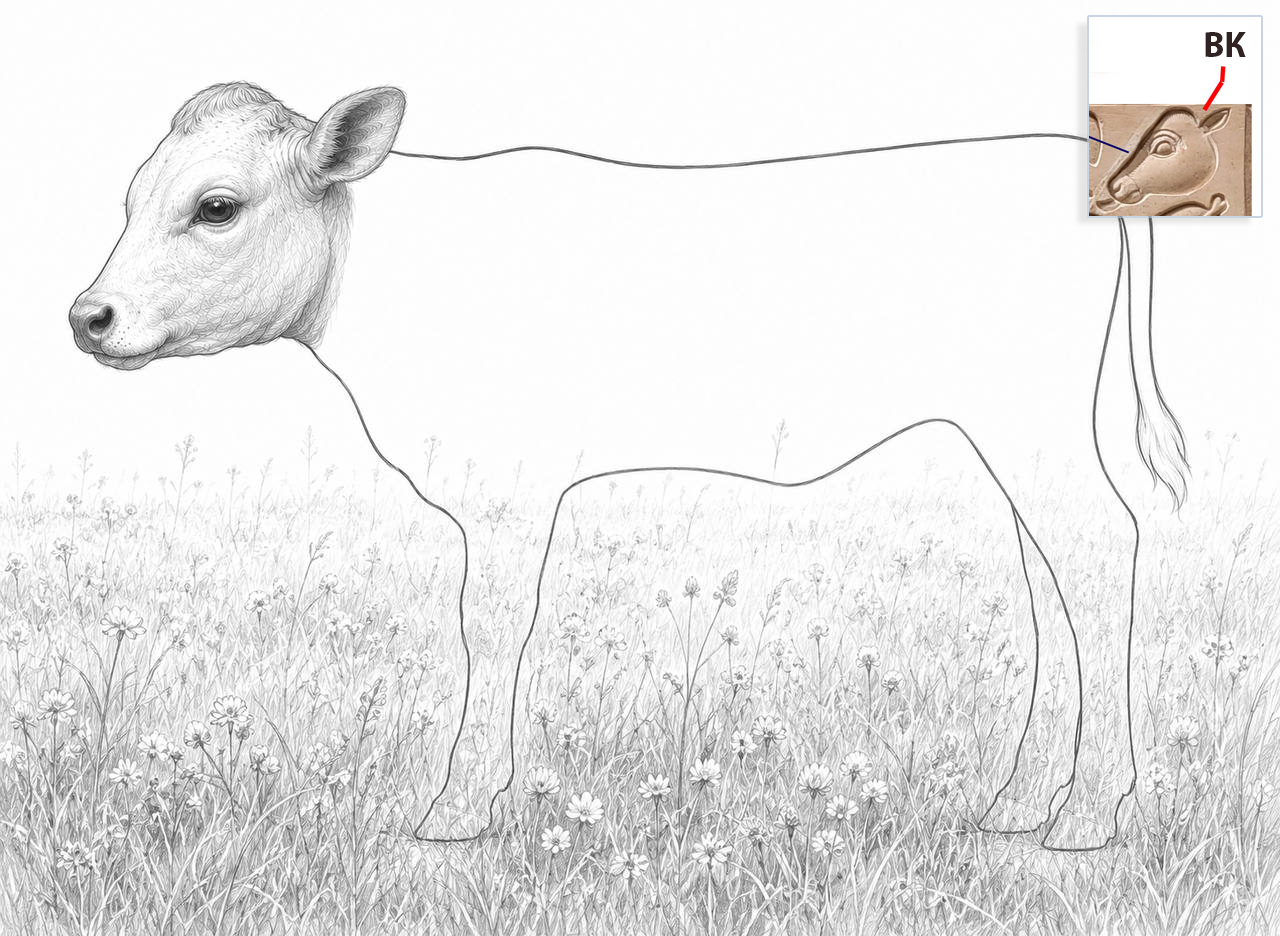
I hope you were able to recognize the fragment of the Egyptian text containing the hieroglyph that is nothing other than the head of a calf. Like every other Egyptian hieroglyph, this one, too, remained unidentified.
I looked at it and thought: the Egyptian author must have chosen this particular image because it conveys, better than any other, the essence of a specific pair of sounds in the language.
The fact that I identified the animal does not mean that the thought-form the Egyptian author intended to express lies in the animal itself. In this particular case, the essence of the image lies in the absence of the body.
Now put yourself in the position of the Egyptian author and try to imagine how you would convey the mind-form VK—the notion of absence or emptiness found in words such as vacancy and vacuum.
I hope it is unnecessary to explain why the Egyptian prophet could not openly depict objects from the modern world. This was not because he was unaware of discoveries yet to come, but because doing so would have interfered with the natural course of their discovery.
In any case, I am confident that you will arrive at the same conclusion I did: perhaps the most natural way to express the idea of absence through an image is precisely to depict a head without a body.
Naturally, the next stage of my work is to collect as many Egyptian texts as possible containing this particular hieroglyph. If reading this sign as VK consistently produces meaningful words while preserving the meaning and coherence of the texts in which it appears, then the conclusion is straightforward: the phonetic value of the hieroglyph has been identified correctly.
You may once again have been puzzled by my statement that the author of the ancient Egyptian texts, being a prophet, knew exactly what the future would be like. Let me add that he knew it as if he were present within the mind of someone living in our own time. In other words, he possessed precisely the knowledge that would later belong to the person whose consciousness ultimately became united with his own.
Oh yes, my regular trolls on social media are quick to mock my bold claim, adding that I am really talking about myself. This is undoubtedly effective from the standpoint of the political-technological task assigned to them: to discredit a person who may become influential in the future.
As for me, I have always said only what I can, at the very least, substantiate well. And in the case of my statement that the ancient author was able to see the world of our own time through the eyes of a person living in it today, this is something I can prove through numerous deciphered texts—or, to begin with, through this very Egyptian hieroglyph.
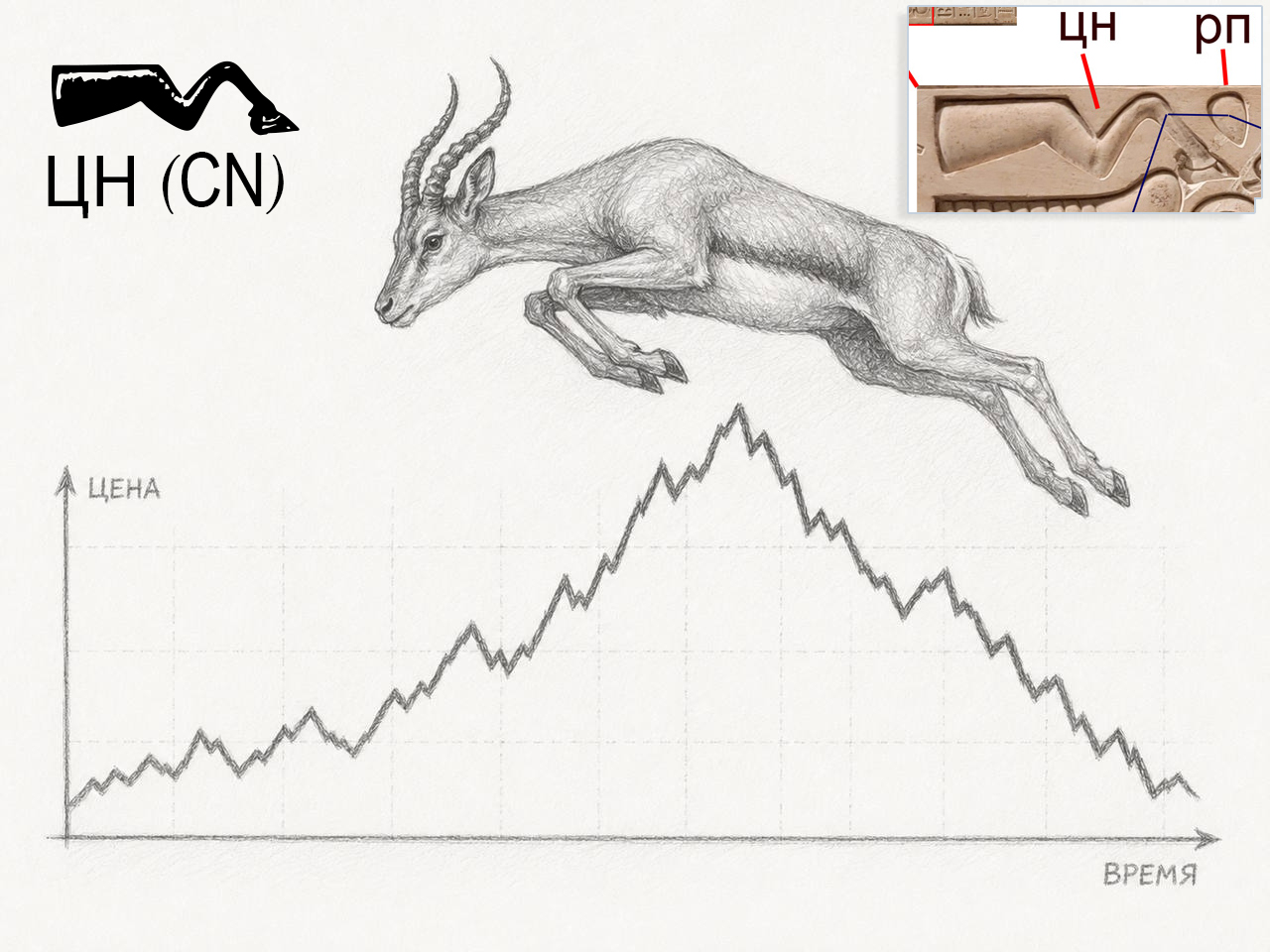
Thus, you can now see for yourself that the hieroglyph, which is clearly the leg of a leaping cloven-hoofed animal, contains one more joint than anatomy would allow. This indicates that, through this image, the Egyptian author was pointing to nothing other than a graph of price jumps.
In other words, the ancient Egyptian author created a hieroglyph with which the following words can be grouped and represented:
Цена (Russian: tsena) — price
As well as the following English words associated with the rise and fall of value:
cent — a unit of monetary value
center — the average value determined by taking into account all rises and falls
percentage / percent — percentage
ascent — a rise in value
descent — a decline in value
incentive — an inducement; an offer of value
I will now formulate the very proof I promised.
Archaeology, on the basis of excavations in Egypt, has established the approximate level of civilization that existed at the time. On that basis, one may confidently conclude that no one in that era was drawing graphs of price fluctuations or of the rise and fall of value in relation to anything.
Therefore, if the creator of this hieroglyph had intended its image to be consciously understood by the people of his own time, he would have chosen a visual representation of the ЦН(CN) mind-form that was familiar and meaningful within their world, rather than one whose significance would only become apparent in the future.I will now formulate the very proof I promised.
Archaeology, on the basis of excavations in Egypt, has established the approximate level of civilization that existed at the time. On that basis, one may confidently conclude that no one in that era was drawing graphs of price fluctuations or of the rise and fall of value in relation to anything.
Therefore, if the creator of this hieroglyph had intended its image to be consciously understood by the people of his own time, he would have chosen a visual representation of the ЦН(CN) mind-form that was familiar and meaningful within their world, rather than one whose significance would only become apparent in the future.
And here is yet another Egyptian hieroglyph that, upon closer examination, will once again make you wonder: could it really be that the ancient author knew the future as though he himself had been here among us?
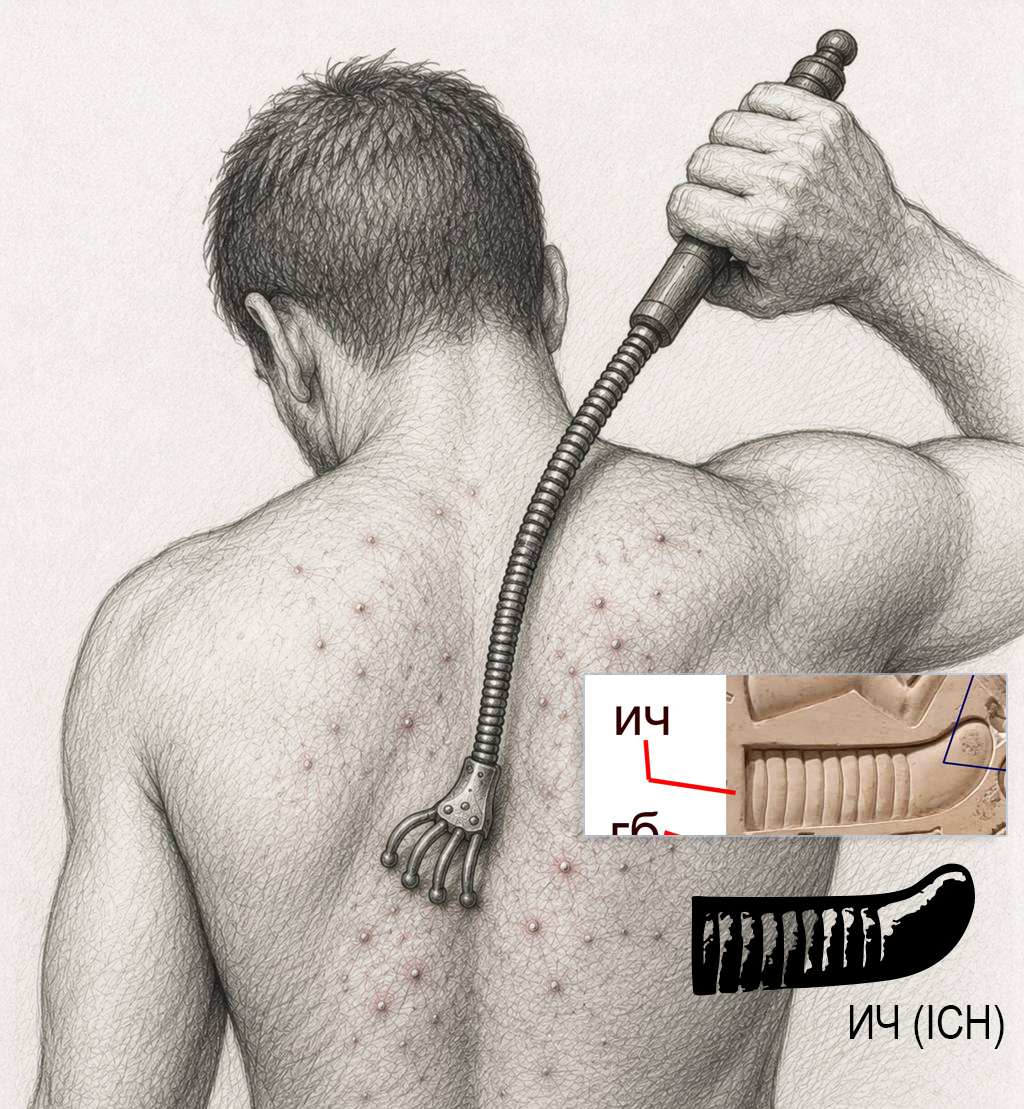
Now this is a hieroglyph seemingly created to spark an argument among three different camps: nematologists, plumbers, and urologists-andrologists over the correct identification of the ИЧ(ICH) hieroglyph.
And indeed, every plumber will say,
“Come on, that’s obviously a metal bellows hose! I bend one of those every single day—whether to connect a faucet or a water heater. And if you’ve been working hard, worked up a sweat, and there’s no one around to scratch your back, it’s a pretty useful life hack too.”
The urologist, however, will object:
“Take a look at that rash on the glans of the penis. What, do you think this hieroglyph just happened to catch a chill in exactly that one spot?”
Then the nematologist is right there:
“What, don’t you see the earthworm? Here is its circular musculature, and here is its prostomium—the pre-oral lobe it uses to push through the soil.”
Well then, have you examined the hieroglyph? Have you decided which of the three is right?
Thus, we must put ourselves in the place of the author of the Egyptian texts. In the case of the hieroglyph under consideration, he needed to depict the ICH hieroglyph in such a way that its image would make it possible to understand both which combination of sounds corresponded to it and what the essence of the image was—and, consequently, what essence that same combination of sounds carries within words.
Of course, the very first word that comes to mind when considering the pair of sounds ICH is itch. The t sound was inserted into its pronunciation only after someone decided to spell the word with a t in order to distinguish it from the word each, which was originally pronounced the same way.
This is perfectly clear to me. The Russian language has the word yaichko, meaning egg. As you can see, the word would have been represented by the Egyptian ICH hieroglyph, while the act of removing an eggshell is, in essence, precisely the action described by the word itch.
Or consider another Russian word: prichoska, meaning hairstyle. It, too, contains the mind-form ICH.
In essence, the word tells us that a hairstyle is created by means of an action connected with itching the head.
I hope that what I have just shown is sufficient for you to trust my assertion that the English word itch originally contained no built-in T and would have been written with precisely the Egyptian ICH hieroglyph that we are now examining.
In fact, what was originally the same word—each, carrying a double meaning—came, over time, to be perceived as two entirely different words with different spellings. What matters to us, however, is to understand the meaning of that word at the level of the author’s original intent.
Let me remind you that we are now attempting to reconstruct the author’s train of thought at the very moment when the idea for the hieroglyph we are examining was first taking shape in his mind.
To convey nothing more than a hint of the sound combination ICH through a hieroglyph, it would have been enough simply to depict exactly what I have just shown as the visual explanation of this hieroglyph—a tool that allows one to scratch a part of the body that is difficult to reach.
The author of the hieroglyph surely thought of this, but deliberately chose not to depict such an easily recognizable object so directly, because the Egyptian texts were not supposed to be read before the appointed time, and discovering how to read them was meant to present a genuine difficulty. A difficulty great enough that, for a thousand years, every attempt would prove incorrect and fail to produce a real result.
What if, instead, the hieroglyph simply showed a rash on some part of the body? I believe this idea also occurred to the author. But a rash could just as easily be mistaken for a starry sky, and such a hieroglyph would most likely be understood as expressing the idea of scattering, randomizing, or dispersing. To guess from such a hieroglyph that the author actually meant scratching parts of the body would no longer be a matter of persistence or of the future discoverer’s level of intelligence, but a matter of following a precisely defined standard of approach. Such a solution lies outside the author’s way of thinking, to which I have become accustomed.
Using the rash as an inconspicuous detail, however, while depicting the scratching tool in such a way that it outwardly resembles the part of the body on which the rash appears, is the perfect solution for the hieroglyph. Looking at this very hieroglyph, I realized that it is read like the English word itch without the letter T — ICH.
But here is the problem the ancient author surely encountered in his own mind. Neither the word itch, nor a back scratcher, nor a curved penis with a rash is sufficient to point clearly to the essence carried by the sound combination ICH in words. That is why the author added an important detail to the hieroglyph. It was this detail that led both the plumber and the specialist in annelid anatomy to their respective interpretations of the hieroglyph. The ancient author expected exactly this, because in this case both specialists are right. All the words containing the ICH hieroglyph are united by a single essence, which is understood through word each in relation to the cause.
And here I must point out that, in Russian, this word cause is - prichina (причина), and it would have been written with the ICH hieroglyph.
I will try to explain the essence of the hieroglyph the way it might be explained by a plumber-fitter who also happens to be a specialist in Ancient Egyptian structural linguistics.
So, in the hieroglyph we see an obvious hint of a bellows pipe, like the kind you may find among plumbing equipment where a metal pipe needs to be bent in order to make a connection.
And now I will point out an important feature of bending such a corrugated pipe. If you take it with both hands and, in one movement, try to bend it to the required final angle, it will most likely kink, and you will have to go and buy a new one.
At the same time, the reason why the pipe kinked is understood precisely through the essence of the ICH hieroglyph—each.
Each!
Each ring segment of the pipe must be bent separately, by a small angle.
And now comes the plumber’s immediate conclusion regarding the cause of any negative result—from the cause of a purely local problem to the cause of a global conflict. And it is precisely here that we need to see the essence of the act of scratching itself.
You try to solve the problem of an unpleasant itch all at once and begin scratching that spot—as a result, it only gets worse.
What about politics? Take, for example, two neighboring states, in one of which, like a rash, people begin appearing everywhere who rather painfully express their hostility toward the neighboring state and its citizens.
Can I draw a parallel with an unpleasant rash and the attempt to scratch it, while also pointing to a pipe broken by trying to bend it in one sweep, and say:
Are we dealing here with a fundamental principle of life?
Exactly. Whenever anyone sets out to transform something that consists of many segments, a delicate influence upon each individual segment is required. Any attempt to affect everything at once by means of a single action, a single decision, is always doomed to failure.
And all of this, compressed to the level of an elementary sensation, is the essence of the ICH mind-form.
And what about an earthworm, with its rings that outwardly do indeed resemble the rings of a bellows pipe, although not everyone would immediately recognize where the similarity of the underlying essence lies?
Once, in early childhood, I was playing with an ordinary optical microscope. I placed beneath it a small, lively earthworm which, for the sake of science, I decided to pin down gently while still alive so that it would not crawl away.
What impressed me was that, while adjusting the microscope, there came a moment when the worm’s rings reminded me of the keys of a piano, pressing down and releasing again in an obviously ordered sequence—or at least that is how it appeared to me, even though in reality I was observing only a very small section consisting of just a few rings.
I remember very well the thought that came to me at that moment: what if it were somehow possible to match every ring of the worm with the keys of a musical instrument, so that each individual ring corresponded to a particular key? At the level of what composer would the music created by the tensions and relaxations of those rings be?
I do not know the exact answer as to what level it would be, but I know with certainty that it would indeed be music.
Thus, any system made up of segments, or any complex object composed of segments, possesses its own pattern when it exists in harmony. After all, music is also a pattern expressed through combinations of sounds. And in every pattern, each segment matters.
If something falls out of the pattern, like a missing note in a musical composition, that is the very cause whose essence is understood through the word each and expressed by means of the ICH hieroglyph.
As you understand, I am not only explaining the principle by which images were chosen for the hieroglyphs, but, above all, I am trying to break the false idea that the hieroglyphs of Ancient Egypt depict objects familiar to the Egyptians at the time when the Egyptian texts were created.
How, then, could Egyptian hieroglyphs be directly connected with specific verses from the Bible? Carefully examine the hieroglyph, which is nothing other than a clear image of a bone lying on top of a tongue.
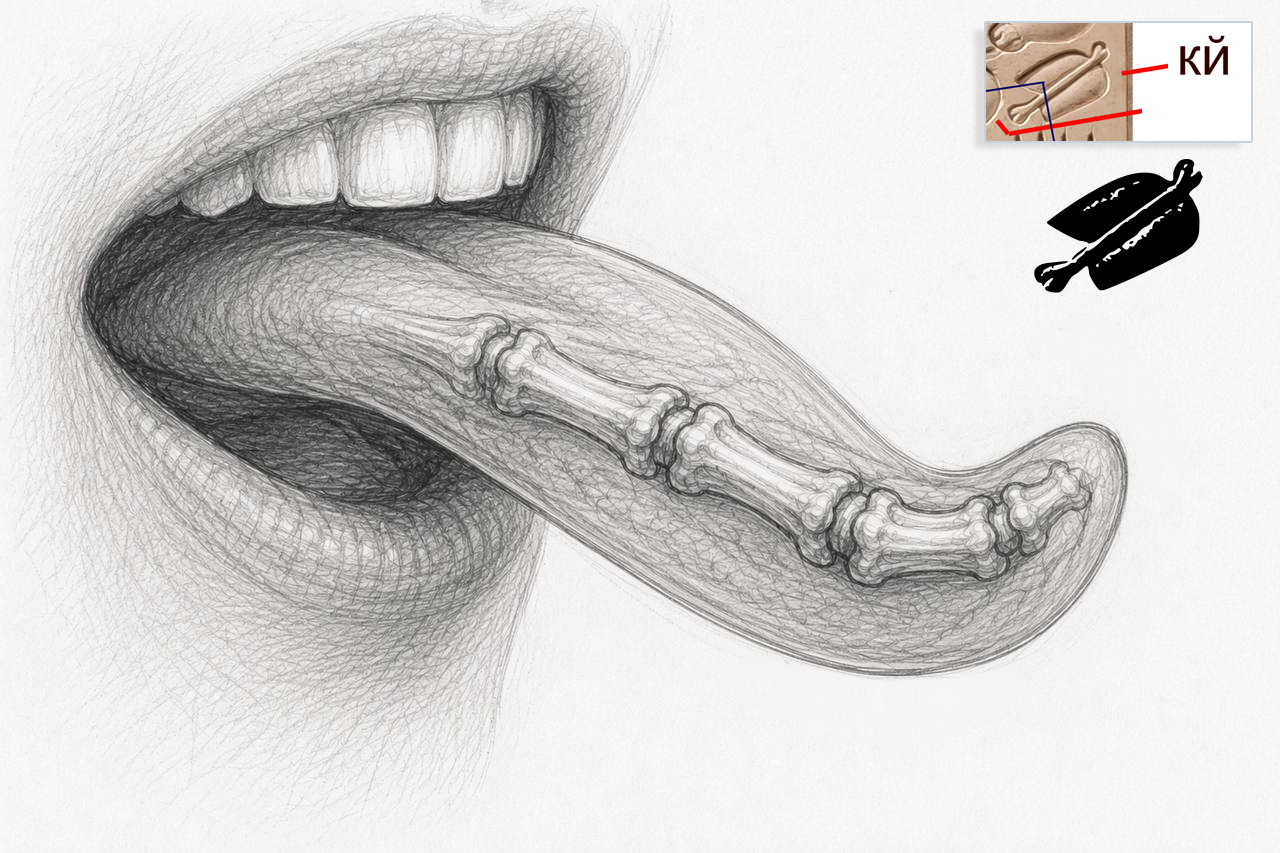
From the standpoint of modern Egyptology, there can be no connection whatsoever between an Egyptian hieroglyph and a verse from the Bible, and my claim will undoubtedly be perceived by representatives of official Egyptology as nonsense.
In that case, let us reason together. You see a hieroglyph depicting a bone on a tongue. What essence could such a hieroglyph possibly hint at? The only thing that comes to mind is that the essence of the hieroglyph is bone-tonguedness, is it not?
Exodus 4:10
Literal Standard Bible (LSB):Then Moses said to Yahweh, “Please, Lord, I have never been a man of words, neither recently nor in time past, nor since You have spoken to Your slave; for I am one with a hard mouth and a hard tongue.”
In the Russian Bible, in this particular verse, the quality of Moses’ tongue is described by the word kosno-yazychnyy. The word itself sounds like a hint that Moses’ tongue bends at joints and is therefore difficult to move. Although the word kost’ (“bone”) is not used directly, both kost’ (“bone”) and kosno-yazychnyy share the same mind-form—OSN—as does the Russian word osnova (“base”, “foundation”).
In other words, Moses is saying that he speaks through the foundations of language—that is, he speaks in mind-forms. For the same reason he says, “I am not a man of words,” because his mind perceives speech not through words but through mind-forms.
Moses perceives and reproduces speech the way it would be represented by sequences of Egyptian hieroglyphs. That is what he means when he says, “I speak with difficulty.” He means that his speech requires his own Little Chief Aaron to figure it out through the system of Egyptian hieroglyphs and bring the real, interpreted Moses to the people.
Later in this book, I will explain in detail that the very bones lying in the field, of which the Book of the Prophet Ezekiel says that they became covered with flesh and skin and became the House of Israel, are nothing other than the actual square field attached to this book, entitled Clavis of Revelation. There the bones have already been gathered together and clothed with flesh and skin.
When Moses created the Egyptian texts, however, he neither gave them voice nor explained their meanings. For that reason, the hieroglyphs in those texts remained, for all that time, precisely dry bones, each one of them being a key to sacred knowledge.
That is why the hieroglyph whose essence is key is read as KEY, while the letter E serves only as a vowel point, much like the Hebrew niqqud.
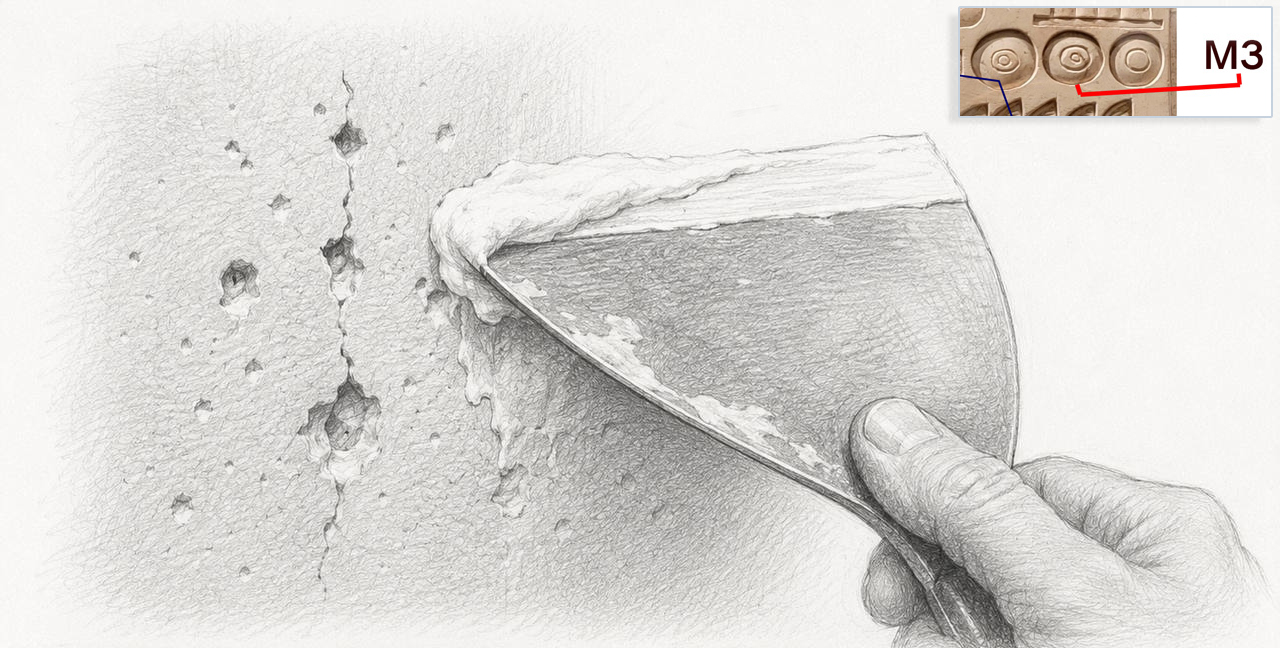
Still hard to believe that the author of the Egyptian hieroglyphs intended to demonstrate a time-bending miracle to our modern generations? Then it occurred to me to speak about the legend of Ivan Mazepa. I will not retell that historical legend—it is well known to everyone, especially its beautiful linguistic conclusion, which many people accept as an actual historical fact.
The story goes that Ivan Mazepa had to choose on which side his Cossack army would fight. He chose to ally himself with King Charles XII rather than Peter the Great. It is then claimed that precisely because of this wrong decision, a new Russian word appeared—promazat’ (“to miss the target”), and that this word is derived from the name of Ivan Mazepa.
You do not have to believe that. I myself do not believe it either, at the very least because, in English, the word muzzle for the barrel end of a firearm is obviously not derived from the name of the Cossack leader who became famous for his unsuccessful decision. You may conclude that such a brilliant linguistic story was most likely predetermined either by a simple coincidence or by someone’s grand invention of a fake history.
As for me, I would like once again to present a hieroglyph over which a sniper and a plasterer will now begin to argue.
The sniper will see three targets, one of which has no hit in the center. The plasterer, on the other hand, will remember how the construction supervisor shines a light across newly finished walls at a sharp angle. Sometimes that is the only way to reveal tiny dents in the surface, after which he circles them with a pencil. Looking at the target without a hole in its center, the plasterer will simply say that it has already been covered over.
Once again, both are right. Once again, this is exactly what the Egyptian author was counting on, because the essence of the MZ mind-form—and therefore of the hieroglyph itself—is spread. Just as the Russian word maz’ means a cream, and a cream spreads farther and farther, plaster is also razmazyvaetsya (spread).
And, of course, repeated attempts to shoot at the same point also have a certain spread. Thus, both the plasterer and the marksman are dealing with spread. Because two entirely different perceptions of the same hieroglyph converge upon the same underlying essence, the consensus itself confirms that this is the MZ hieroglyph whose essence is spread. And this, in turn, proves that the word promazat’ is not derived from the name Mazepa.
Now we will move on to another hieroglyph, and I immediately invite you to examine it carefully. I think that, had I not accompanied the hieroglyph with an explanatory illustration, the standard first thought would have been: what in the world could this unimaginable thing be? It is somewhere between a little dog’s face, a galosh, or a shoe with a special heel spoon for lazy people who want to pull their shoes on without untying the laces.
Or perhaps it is a decorative mug shaped like a little dog’s face, into which something is being poured from above along a ballistic trajectory. Or maybe the author wants to say that it is the little dog itself urinating into someone’s shoe.
If you saw all of that, congratulations. That is exactly the kind of perception the author of the Egyptian text was hoping for when creating the hieroglyph.
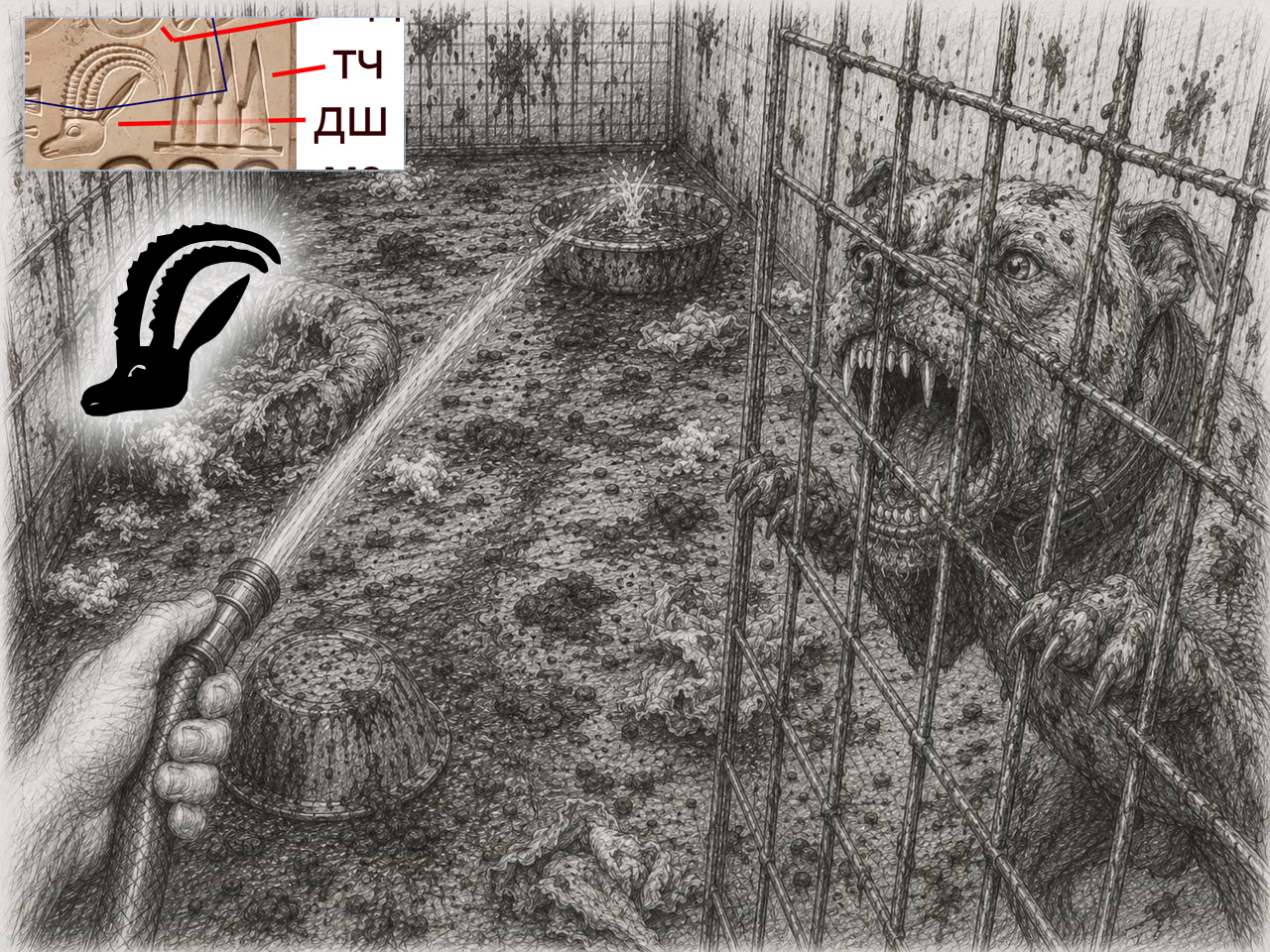
First of all, it is necessary to understand the following: when a hieroglyph appears strange, it is because the optimal way to convey a particular essence through an image requires exactly such an approach. There are no frivolous hieroglyphs in Egypt, nor can there be. Therefore, no matter how absurd a hieroglyph may seem at first glance, it demands careful examination.
For example, the hieroglyph we are now considering has a distinctive feature: not all of the water enters the container. One stream is shown missing it. This immediately leads to an important question: why are the streams shown passing over the top and only partially filling the container?
We are dealing with the problem of representing the intended scene while preserving the compact form required of Egyptian hieroglyphs. In reality, the only situation in which there is a need to pour water in a high arc so that the stream reaches a container at a distance is when the container is located somewhere one does not wish to enter. For example, this is how people pour water when they do not want to step into an animal enclosure. And if the hieroglyph resembles a little dog, then it is precisely this scene that the author encoded into the hieroglyph.
The dog’s head with its open top, while at the same time representing an ordinary container to be filled with water, points to the following analogy: just as a vessel is filled with water, so too is the being itself—whose consciousness needs to be filled—filled with a new understanding, again from a safe distance.
In the Russian language there is the word dusha (“soul”). That word would be written with the very DSH hieroglyph we are now examining. The word dush (“shower”) would also be represented by this hieroglyph. This word is, first of all, the key one in connection with the hieroglyph itself, because a head with water pouring down onto it immediately brings the word dush (“shower”) to mind.
The truly key Russian word, however, is doshlo (“it reached through” / “it finally sank in”), because this is the word the author actually had in mind. On the one hand, it can be visualized as water being poured from a hose over a great distance, with only a few drops reaching their destination. On the other hand, the same word is connected with understanding—as when, for a long time, a person does not realize something, and then at last doshlo. In other words, spiritual filling has brought about a spiritual transformation.
Why, then, the shoes—and especially the shoehorn? This becomes clear only after the hieroglyph is unpacked into the full picture intended by its author. As an example, he points to the soul of an angry dog that you are afraid of, and therefore you give it water without entering the enclosure. Meanwhile, at the very thought that you may still have to step inside, your own soul “goes down into your heels.”
The Russian expression “the soul goes down into the heels” is familiar to every Russian speaker. It serves as confirmation that the hieroglyph concerns the way a Higher Being acts upon the soul of a wild human being, with whom emotional and spiritual closeness is about as dangerous as stepping into the enclosure of a dog that is not yet ready to become a friend of man.
Now, for the sake of a complete understanding, I would like to present to you the entire block of the Egyptian text from which we have just been examining individual hieroglyphs.
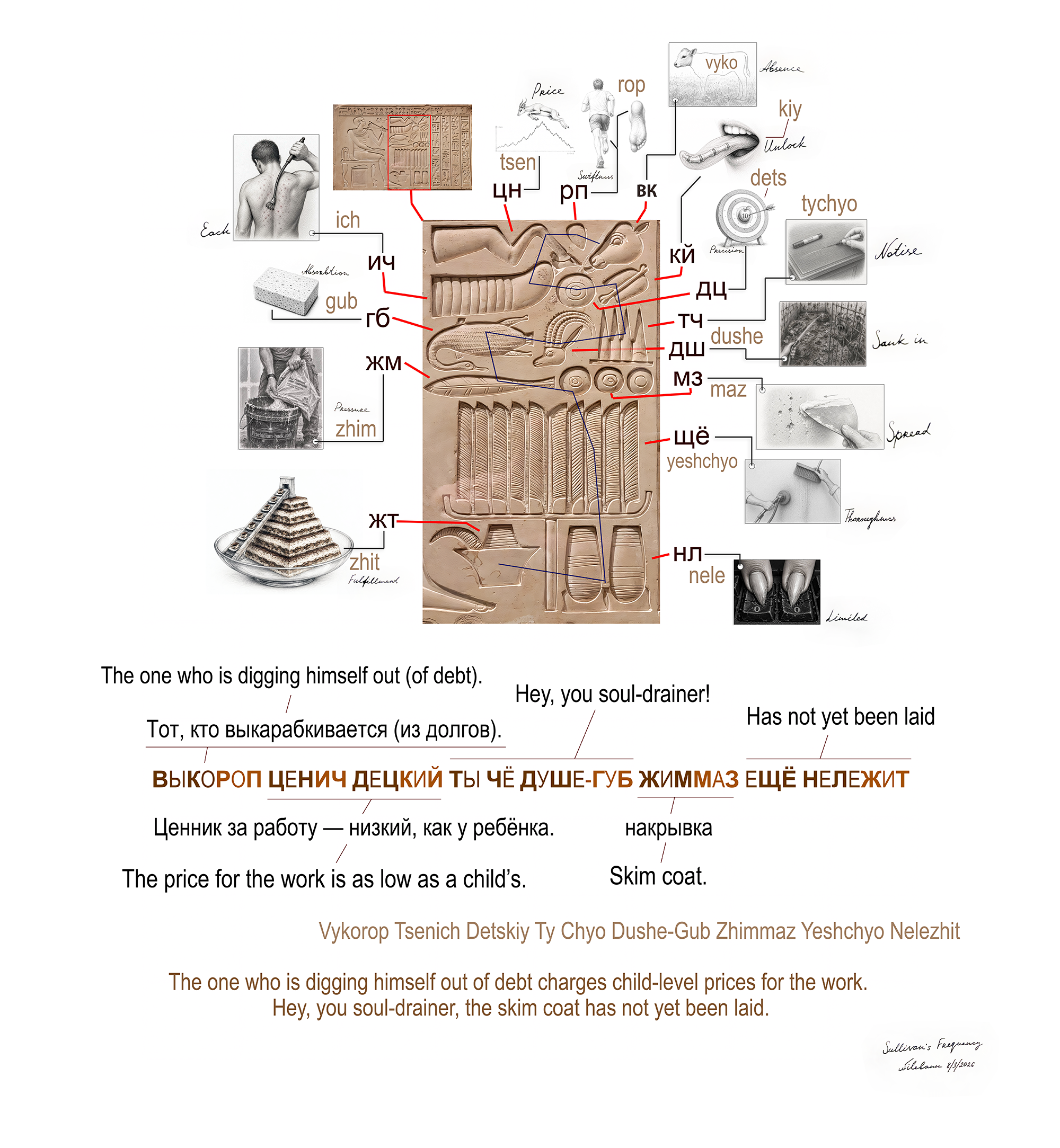
The work Sullivan’s Frequency, which I hope you have studied carefully, offers far more than merely a reading and translation of an Egyptian text. It also reveals something hidden beneath its outward form. This is precisely what Moses meant when he said that he “speaks with difficulty.”
On the one hand, it has become my artistic signature to handwrite, directly on each NFT, those words that I consider especially meaningful. On the other hand, the idea is that anyone who takes the time to decipher my handwriting will, at the same time, be encouraged to reflect more deeply on the hidden essence being assembled beneath the surface.
Besides conveying an ordinary meaning, the hieroglyphs also reveal its higher—sacred—equivalent. I know this may sound somewhat confusing. It is difficult to express an idea that has never been expressed before. Therefore, it is better to demonstrate it with a living example.
Let us take the first two hieroglyphs together with the words that reveal their essence:
VK — Absence
RP — Swiftness
From these two words, a common meaning emerges. One may imagine someone striving to quickly fill what is absent. This is still the ordinary level of meaning, applicable to any context.
However, if we also take into account that the first hieroglyph is represented by the head of a cow precisely because the Red Heifer is the Book of the Torah, then its sacred meaning is that everything hidden within this book—its undeciphered content—is now absent. In essence, what people study today, even with great seriousness by rereading the Torah, is only the head of the Red Heifer, while no one sees its body.
As for the second hieroglyph—the heel—it was conceived in connection with a particular legend. Do you remember Achilles’ heel, the vulnerable point of Achilles? That heel is nothing other than the Five Books of Moses. And yes, Moses is Achilles.
The legend of Achilles reveals its secret through the Russian language. In the legend, the word piata is used. This word simultaneously means both heel and a quantity of five. The legend also deliberately emphasizes that the piata is uyazvima (vulnerable). Within the Russian word uyazvima there is the image ЯЗ (YAZ), whose essence is language.
Thus, the decoded essence of the legend is that the Five Books of Moses will be deciphered, and people will come to know the higher truth.
Thus, while the Egyptian text may, on its surface, appear to be nothing more than timely advice to a friend from the future—not to apply primer to a wall until the skim coat has been properly applied, otherwise the result will only become worse, since he already knows what is going to happen—in its deeper structure, the text was designed to serve merely as the wrapping for something far more important.
So, in the first two hieroglyphs we have read the word Vykorop. And now, after I have fully explained those hieroglyphs, it becomes possible to recognize that together they point to the striving to fill the Torah with its previously absent body as quickly as possible.
By the way, as you study this book, you are witnessing that very process.
Notice also the DSH hieroglyph—the shoe with a shoehorn, intended specifically for the heel of Moses—for the body that is being filled, the body of his Five Books.
The streams of water shown in the DSH and ZHT hieroglyphs, reaching the vessel from a distance, represent the very process of filling the “body of the cow.” In biblical terms, this process is called revelation.
You are already beginning to notice how all the hieroglyphs are united into a kind of symphony of mind-forms.
Let us now move on to the next - Tsenich Detskiy combination of meanings:
ЦН(TSN) — Price
ИЧ(ICH) — Each
ДЦ(DTS) — Precision
КЙ(KY) — Unlock
Applied to the work of deciphering the Torah, this combination becomes quite straightforward. Each unit of meaning increases in value as one penetrates more deeply into its hidden essence—value itself being another form of price. At the same time, precision in working with each such unit determines whether it can successfully serve as the key by which the sacred knowledge is unlocked.
Let us move on.
“Zhimmaz eshchyo ne lezhit.”
ЖМ(ZHM) — Pressure
МЗ(MZ) — Spread
ЩЁ(SHCHIO) — Thoroughness
НЛ(NL) — Limited
ЖТ(ZHT) — Fulfillment
Take a look at the developing Clavis of Revelation table. Many of its cells are still empty. That is precisely limited fulfillment. It requires pressure for spread to take place across the entire table, so that the missing hieroglyphs and their empty cells—the very holes in the plaster—may finally be filled.
It was no accident that the ancient author depicted the most important hieroglyph as the largest one of all—the broom - ЩЁ(SHCHIO).
In every kind of work there are tasks that can be neglected. For example, very often one can paint a wall without first sweeping the dust from it.
We have just discussed the fact that every hieroglyph possesses a higher meaning. Now pay attention to the broom’s bristles. Each bristle represents a separate piece of work performed by the author—a single expressed thought, or, for example, each individual hieroglyph that he created.
A plasterer who is in a hurry to earn a living may either give every such bristle its proper place in the Grand Decipherment or neglect some parts of the work.
And now I have explained the author’s principal message: carry out the decipherment thoroughly.
From now on, I will try not to spare my reader, but will unload everything in full, without concealing details merely because they may not seem particularly necessary. Such as the following:
I must now explain the essence of the ZHT hieroglyph. And, not without embarrassment, I have to admit that no matter how hard I tried, I was never able to determine its essence from the image alone.
In the case of this hieroglyph, the author of the Egyptian texts had to make an exception. Acknowledging that the task was impossible, he explained its meaning to me directly. The image represents a dessert whose very name is itself an important biblical key—Tiramisu.
You have probably heard that all living beings on Earth are called terrestrials. That is because what we call Earth is, in fact, Terra.
The next part is the principal mind-form MIS, the same mind-form found in the word mystery.
Finally comes the image U, just as it appears in the Russian words uchenie (“learning”) and urok (“lesson”).
As I mentioned earlier, what appears in the hieroglyph as a horn, a spike, or even a claw is, in fact, the stream of biblical water filling the bowl of tiramisu.
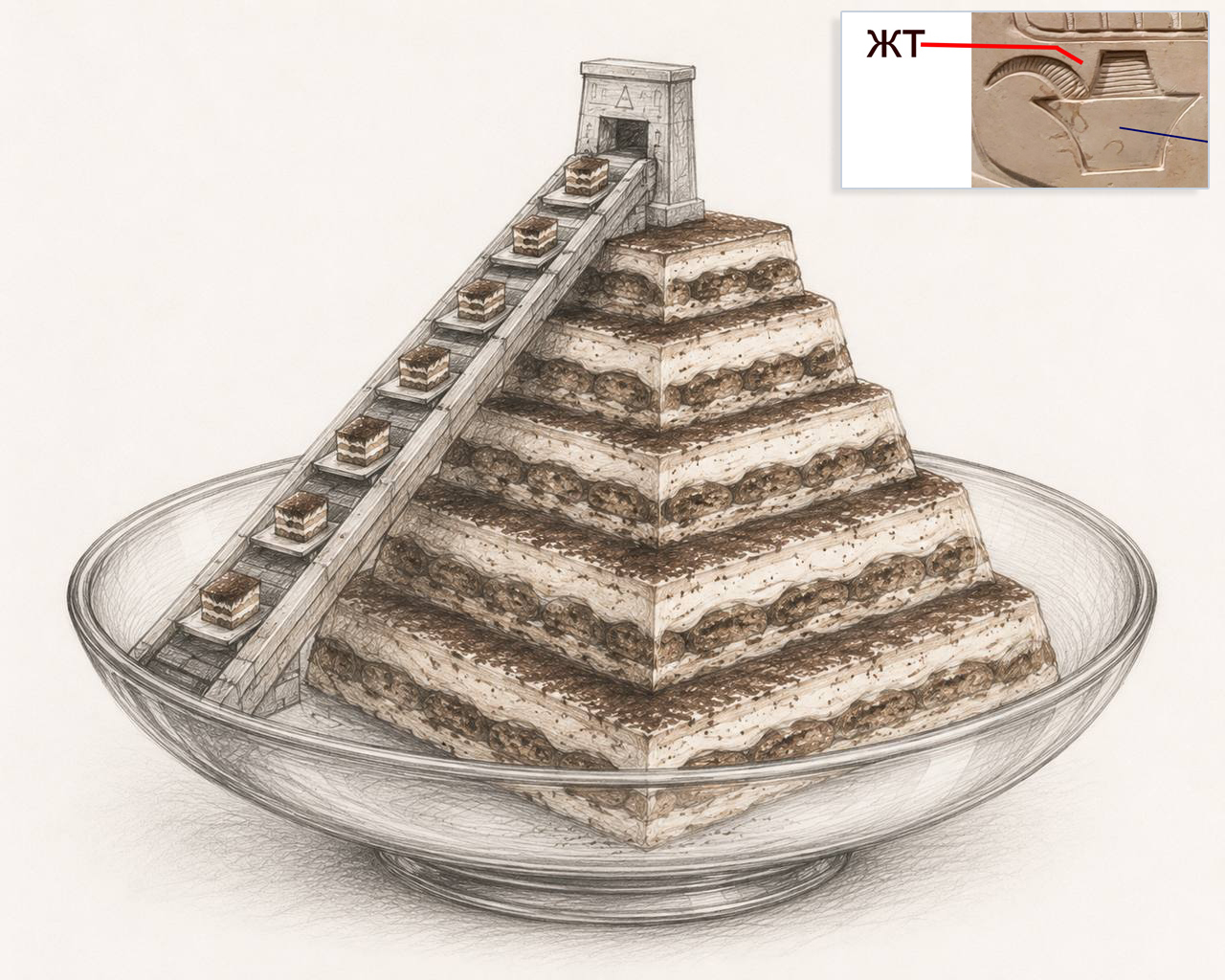
In other words, the fulfillment spoken of in the deeper narrative is the filling of the human mind with Terra–MIS–U.
The essence of the ZHT hieroglyph is understood precisely through the word fulfillment.
In the Russian language there is the word zhatva (“harvest”). This word contains the ZHT mind-form. Its presence makes the word deeper and more precise, because zhatva is the time when the storehouses are fulfilled with the new harvest.
Another thought that I have little desire to share in this book concerns the word ZITKOST’, or VATI—the true word denoting the biblical water itself.
Of course, Russian speakers came to understand it incorrectly. To them, it appears to be nothing more than the word liquid with the letter D replaced by T. Yet many native Russian speakers—especially those who were largely raised by their grandparents—still pronounce it the old way, as ZITKOST’, with a T.
There is little point in arguing with those who do not recognize the same underlying pattern. Just as, in one era, an influential official may compel citizens to give up unrestricted access to the Internet, in another era an influential official may decree that Russians should no longer write ZITKOST’ with a T.
The same official, however, had no authority over other Slavic peoples. Serbs, Croats, Bosnians, and Montenegrins, for example, have preserved the ancient pronunciation and continue to write the word as
žitkost
Thus the sequence of mind-forms is perceived in its pure form, beginning with the mind-form ZHT—Fulfillment, whose sacred equivalent, as revealed by the hieroglyph we have just examined, is Biblical Revelation.
What follows is an attempt to put into words what is meant to be understood beyond words—at the deeper level of subtle nuances and pure mind-forms:
In the striving to swiftly fill the absence of the deeper biblical essence within human consciousness, raise the value of each key by carrying out each of its unlockings with precision.
Using pressure, spread the keys throughout the field and exercise thoroughness, for the Clavis of Revelation has not yet reached its full fulfillment.
Revelation 1:16 (KJV)
“And he had in his right hand seven stars: and out of his mouth went a sharp twoedged sword: and his countenance was as the sun shineth in his strength.”
I have quoted this verse at this very moment while the memory is still fresh in the reader’s mind of how two distinct meanings emerged from a single ancient Egyptian inscription. These are the two edges of the sword that proceeds from the mouth of the author of the Egyptian texts. For it is he of whom John bears witness in this very verse of his book.
Andrei Bannikov. “Introduction.” Praeludium for Vatican. Digital First Edition. 2026. https://praeludium-book.com/chapters/introduction.html