The Admonition of “Cleopatra”
A Hieroglyphic Sedative for the Tempted Stork
If just one influential person, holding this book in his hands, chooses the right direction, the immeasurable treasure will return to every human being born upon the Earth.
For it is this very choice of direction that restores the world’s vitality.
I do not expect anyone to begin meticulously studying the NFT presented here the moment they see it.
But I am quite certain that the first person who realizes it could elevate his financial or social standing will immediately reach for a magnifying glass—and a strong cup of coffee.
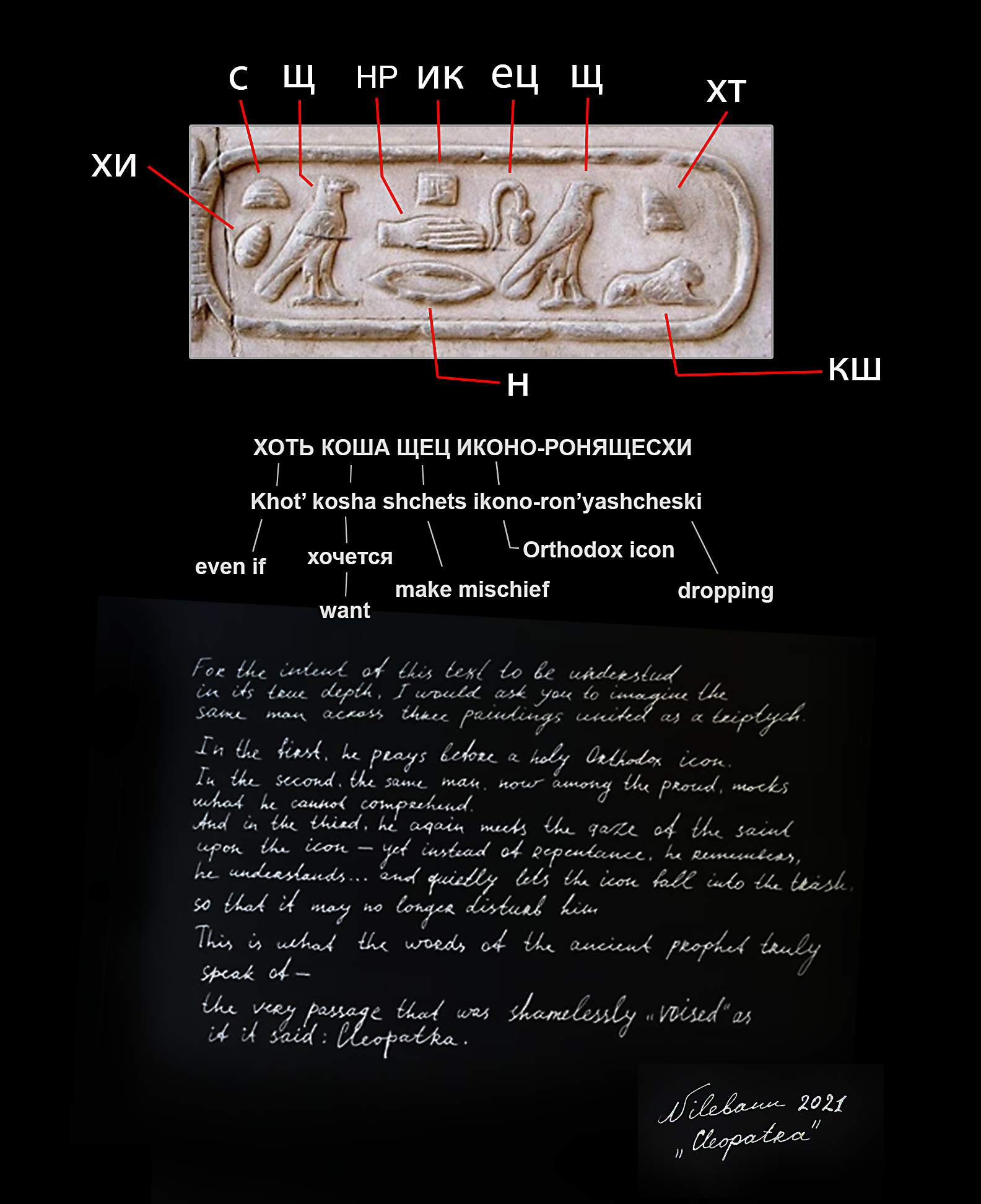
Why, then, is the artwork before you called Cleopatra?
Because Cleopatra is precisely the name that academic Egyptology has read in this cartouche and continues to insist that this sequence of hieroglyphs should be read as “Cleopatra.”
Many of those Egyptologists—particularly within the Russian-speaking academic community—have already become familiar with my discovery. Yet acknowledging my system would, for many of them, amount to the collapse of their own reputations as Egyptologists and linguists.
At this point, I shall interrupt the sequential flow of my narrative and explain, thoroughly and step by step, the meaning of several key hieroglyphs contained in the NFT “Cleopatra.”
In doing so, you will be able to appreciate just how primitive the ordinary transmission of thought through words really is when compared with expressing the very same thought as a carefully ordered sequence of hieroglyphs.
In my NFTs, the hieroglyphs are annotated using Cyrillic letters. This is because, unlike the Latin alphabet, each letter of the Cyrillic alphabet corresponds consistently to a single specific sound, regardless of the language in which the text is written.
This makes the phonetic structure of each hieroglyph considerably clearer and avoids many of the ambiguities that arise when the Latin alphabet is used for the same purpose.
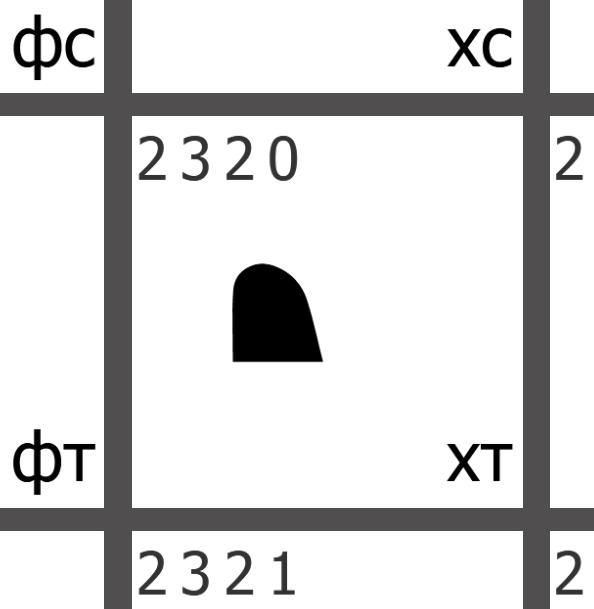
The first hieroglyph on the right is labeled in Cyrillic as ХТ, or HT in Latin letters. The essence of this hieroglyph is attraction.
I should say at once that, when taken out of context, this hieroglyph may be read with the vowel O inserted between its principal sounds, producing the English word hot.
Yet the unified context of the entire text makes it clear that, in this particular case, the hieroglyph should instead be read as the Russian word khot’ (хоть), meaning “even if.”
At the same time, this word is derived from the Russian verb khotet’ (хотеть), whose English equivalent is “to want.”
Notice that what is desired is what appears attractive, and we may also call it hot. But why?
Because the mind-form HT carries the same essence regardless of whether attraction manifests as a physical force or as an emotional impulse. It may be a line of buyers attracted to an appealing product, several young men attracted to a hot girl, or matter in a liquid or gaseous state drawn toward a region where it is hot.
The hieroglyph HT—ХТ in Cyrillic—is shaped in such a way that one person may see a snowdrift, while another may see a sand dune. It does not matter whether it is snow, sand, or even a wave upon the surface of a liquid. The hieroglyph depicts an uneven distribution: most of the substance gathers where the force of attraction is acting.
After all, a sand dune or a snowdrift forms precisely where particles of sand or snow are drawn and gathered together.
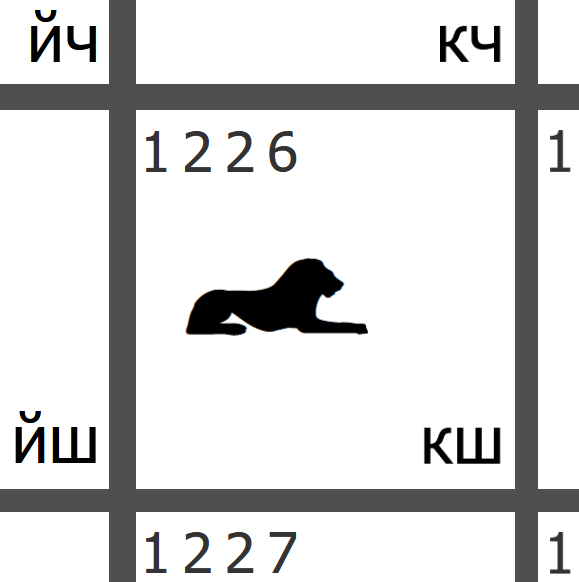
The next hieroglyph in the text under examination is the image of an ordinary domestic cat, depicted in exactly the same pose in which this very hieroglyph—when not stylized—normally represents a lion, which, after all, is simply a much larger cat.
This hieroglyph is read KSH (written КШ in Cyrillic).
Now let us determine the essential meaning of this hieroglyph by asking ourselves a simple question:
What is unique about a cat?
Precisely that unique characteristic becomes the essence conveyed by the hieroglyph.
I believe anyone who has ever lived with a cat will agree that a cat’s defining quality is its free will. In other words, a cat cannot truly be commanded. It goes wherever it pleases.
Now let us examine several words that would be represented by this hieroglyph and see whether they are all united by the same underlying meaning.
Remember that, when dealing with hieroglyphs, we are concerned with pronounced sounds, not with the conventional spelling of words.
Cash — unlike a check or a bank transfer, cash allows its owner to exercise free will.
Koshka — the Russian word for cat, which, as we have already observed, constantly exercises free will.
Koshmar — the Russian word for nightmare. Unlike the English word, however, a koshmar does not have to occur during sleep; it may just as easily happen in broad daylight.
For example, the very same cat may decide to claw your brand-new sofa or knock your flowerpots onto the floor. A lion, in that respect, is an even greater koshmar.
Thus, the essence of the KSH hieroglyph is the impossibility of control.
Consequently, the first two hieroglyphs together are read as Khot’ Kosha—“Even if you want…”
Yet beyond this literal reading, the combined meaning of the hieroglyphs conveys something deeper:
the author is unable to forbid the action toward which another is drawn.
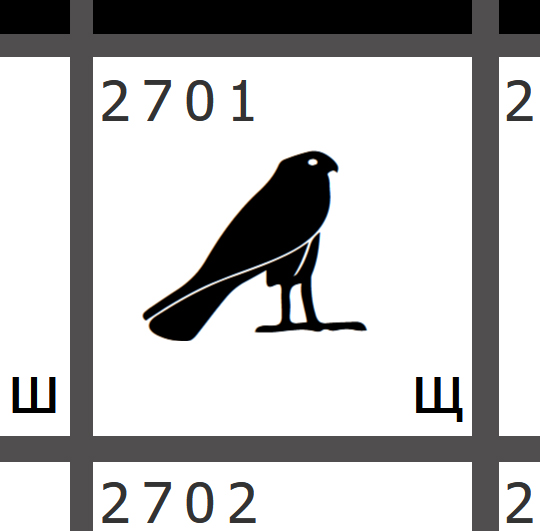
The next hieroglyph is a falcon, depicted from this particular angle. In Clavis system, it is read as Щ (Shch in Cyrillic).
It is this very Cyrillic letter that corresponds to the initial sound of the most common English profanity referring to the final product of digestion—something that, whether literally or figuratively, may end up smeared across one’s face.
Of course, the essence of this hieroglyph is not the substance itself, but the presence of those base human qualities that cause others to mark a person as “Щ” It is this very “Щ” that renders such a soul liable to be destroyed by the predator of the subtle world, whose symbolic representation is the falcon.
To understand the bird hieroglyphs—as with all hieroglyphs depicting birds—one must first understand the common principle that unites the entire group.
In the subtle biblical sense, a bird represents a teacher.
Each Egyptian bird hieroglyph is, in a sense, a teacher of a particular concept, much as each academic discipline teaches a particular branch of knowledge.
The falcon is one such teacher.
We may already be drifting quite far from the main subject, but I should nevertheless satisfy at least ordinary curiosity, if only briefly.
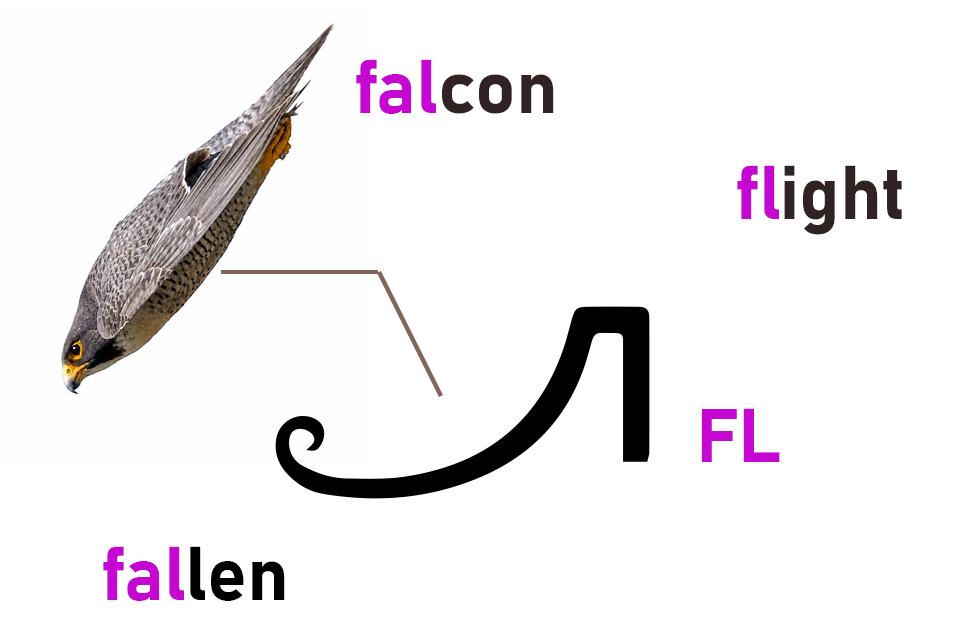
The names of the falcon in different languages, represented through hieroglyphs, reveal that the discipline it teaches begins with observing how the fastest bird literally dives upon its prey, folding its wings completely to achieve maximum speed.
Now let us simply represent the name falcon through hieroglyphs.
The first hieroglyph is FL. This same hieroglyph would be used to write such words as flight, flow, fall, and, most importantly, fallen, as in fallen angels.
In this case, however, the essence is conveyed best by the FL hieroglyph itself, once one realizes that it represents a kind of graph of the falcon’s flight: ascent, flight, the search for prey, and the dive that transforms into a vortex.
The vortex, however, belongs more to the true essence of the phenomenon taking place beyond perceived reality.
In fact, that is precisely what this science is about.
The superficial meaning of the FL hieroglyph is the graph of flight, whereas its deeper meaning is the graph of the transformation of frequencies during the conversion of the subtle etheric body into matter.
If you wish, the falcon is the teacher of understanding how that which we perceive as solid matter comes into existence within our reality.
As for the second hieroglyph in the word falcon—KN—for now, simply accept this image together with the closest corresponding word: canon, essentially the original source, the primary book.
In later chapters, the full meaning of this hieroglyph will be revealed, and you will most likely assemble the complete picture yourself.
Of course, over the years spent looking at the Egyptian text we are analyzing, many have surely noticed that the falcon hieroglyph appears twice within the cartouche. However, a deliberate distinction has been made between these two occurrences of the same hieroglyph Щ(Shch).
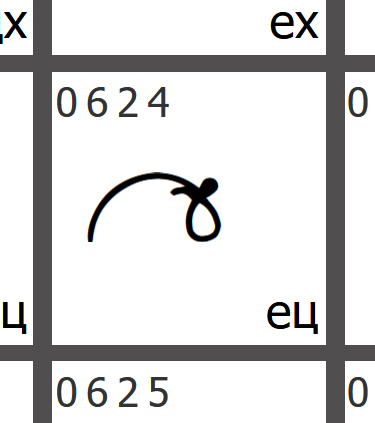
The second Щ (Shch) has a worm in its beak. The worm also is the stylized ЕЦ (ETS) hieroglyph that immediately precedes "Щ" in the cartouche, ЕЦ (ETS) hieroglyph's essence is end (death). This serves only to confirm that the ЕЦ (ETS) hieroglyph is stylized and that it is indeed a worm being devoured.
What is important, however, is something else.
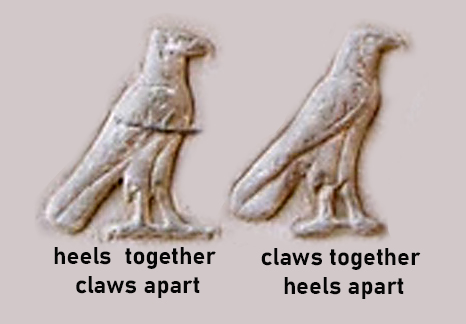
Notice the position of the falcons’ feet. One falcon has its heels together and its claws apart, like the first position in ballet, while the other has the opposite position: its claws together and its heels apart.
Think about what particular kind of activity includes a movement that contains both of these positions.
I will give you a hint. There is a sport—or even an art—in which students perform this movement during one of their very first lessons as the simplest footwork maneuver. This maneuver is called a swizzle.
Thus, we have the falcon hieroglyph Shch and the hieroglyph EC, which in its standard form represents a rope with a loop at its end, but in the version under consideration is stylized as a worm in the mouth of a fish, although its overall shape remains the same EC hieroglyph.
Together, these two hieroglyphs yield the reading Shchets.
In Russian, this word is used in two senses. The first is when offering a guest the traditional Slavic cabbage soup known as shchi. The second refers to inappropriate or outrageous behavior.
However, the two hieroglyphs underlying the word point to an attack upon someone in one form or another, after which everything immediately comes to an end.
For example, it may be a harsh criticism of a person or an organization, after which no relationship will remain.
And that fish’s head, held in a perfectly vertical position with its mouth open upward, is a very specific hint.
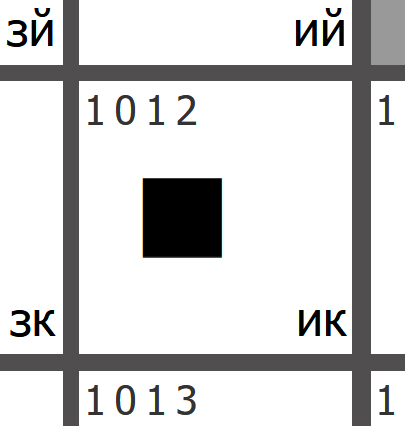
Next comes the square hieroglyph, which in this particular series is stylized as a painting, while its essence and its reading remain unchanged. The essence of the square lies in the equality of its sides and angles, and in language the concept of equality is conveyed through the sound combination IK, as in the word equal.
Next comes a hieroglyph in which some will inevitably recognize the posture of a person at prayer. In fact, it is the very same position of the hands at the moment a diver enters the water.
Notice that the Russian word nyryat’ (to dive) contains the thought-form NR, while in English we find the word narrow, which carries this same hieroglyph. Observe the relationship between the words nyryanie (diving) and narrow, for the body’s position during a dive is meant to allow it to pass through as narrow an opening as possible.
The essence of the tradition of keeping the palms together, as during a dive, is connected with the NR hieroglyph itself, whose deeper essence is range.
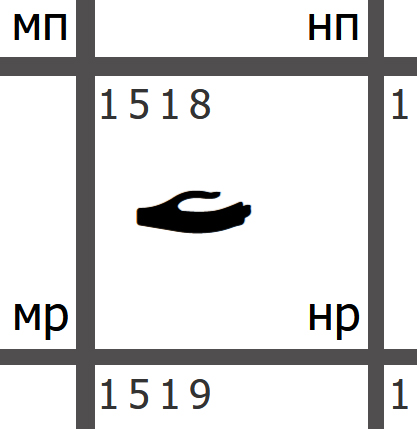
Consider the Russian word NRavit’sia, which means to like something. We like something only within a certain range—for example, ice cream that is neither too melted nor too frozen.
In essence, prayer is the same kind of dive, although that already falls somewhat outside the scope of this chapter.
However, you will surely notice that the words chosen for the reading are divided in such a way that the NR hieroglyph is split between the word ikona and the word roniat’ *(to drop). This is a subtle hallmark of the author’s style: he does this only when it is truly important, as in this example, to depict the hands joined in prayer.
A single delicate touch of one understood hieroglyph—and the course of future events is redirected away from destructive temptation.
Yes, I know that delving into the essence of every hieroglyph places a considerable burden on the cerebral cortex, so I will immediately skip ahead to the one I consider important to explain at this point.
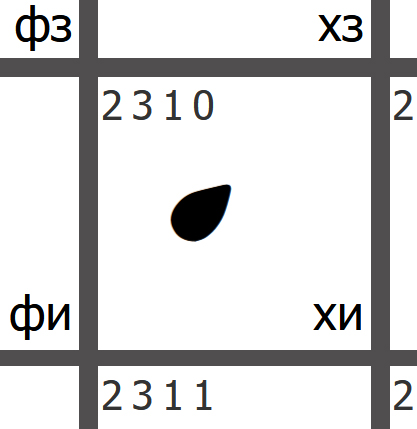
The HI hieroglyph, as in the Russian word khitrost’ (cunning), and as in the word khimichit’, which means to create a complex structure that involves a degree of risk that something may depart from its intended course of interactions.
This hieroglyph is nothing other than a heel. But not just any heel—the heel of Achilles. In the legend of Achilles, that heel itself represents the Five Books of Moses. And the author of those books, Moses himself, is the legendary Achilles.
His pyata (пята) means both heel and five in Russian. The name Achilles contains the word hill.
Those five books of Moses—Achilles—are, in Russian, the uyazvimy spot/hill - уЯЗвимая пята (vulnerable spot/five). This expression contains the mind-form ЯЗ(YAZ), whose essence is the tongue—the language itself. Thus, the legend of Achilles is about how the Five Books of Moses would one day be deciphered through language.
The essence of the heel hieroglyph, HI, is complexity.
Of course, to someone who is only just beginning to explore this entirely new subject, it may seem that I am weaving together works separated by a considerable span of time, with no apparent connection between them.
Please do not judge the capabilities of the Higher Consciousness by the limitations of your own. By doing so, you greatly restrict your ability to attain a deeper understanding of the world.
A world that has yet to face the confirmation of the existence of telepathy beyond space and time between prophets—and not without the participation of God.
By the way, here is a thought about superficial judgment — one that Hieronymus Bosch himself surely cultivated. Otherwise, he would never have allowed the profound realism of his work to be dismissed as insane surrealism.
What is wrong with the beak?
In today’s world, this is called a shadow ban, which people superficially perceive as nothing more than an inability to achieve popularity.
Now ask yourselves: among all those outspoken art critics, how many have, over the entire existence of this famous painting, actually noticed the stork with its neck bent beneath the cloak, making it look more like a hunchback.
Why is it so important which bird is carrying the letter in its beak?
Very well, I will explain through a visualization exercise. Take the name of the bird, STORK, and replace the three letters TOR with the image of an open book—the Torah, the very Five Books of Moses.
Now it becomes clear how important it is that this is specifically a stork and not some other bird. Yes, exactly—because the stork represents a person possessing a specific ability reflected in the name of the bird itself.
And the fact that Bosch depicted the bird in a way that makes it difficult to recognize merely depicts the unwillingness of “specialists” to penetrate into the essence. In the end, this is not about whether the museum curators recognized the stork. It is about everything else that truly matters in relation to The Temptation of Saint Anthony — everything that no one has taken the trouble to understand without being compelled.
There is nothing more laxative than planning to write about yourself. Yes, I did not make a mistake. Just as Hieronymus Bosch did not accidentally leave that little blot beneath the supporting point of the feathered skater carrying a letter in its beak.
Have you ever had the audacity to send the most important document in the world to its most influential prince without even having the decency to use DHL?
By the way, everyone has become so accustomed to Bosch surrounding everything with berries that, when they look at the letter sealed with a pinkish lump of wax, they all assume it is nothing more than a charming little cherry. And as long as they keep seeing a cherry instead of a seal, they will never read the word Щitso.
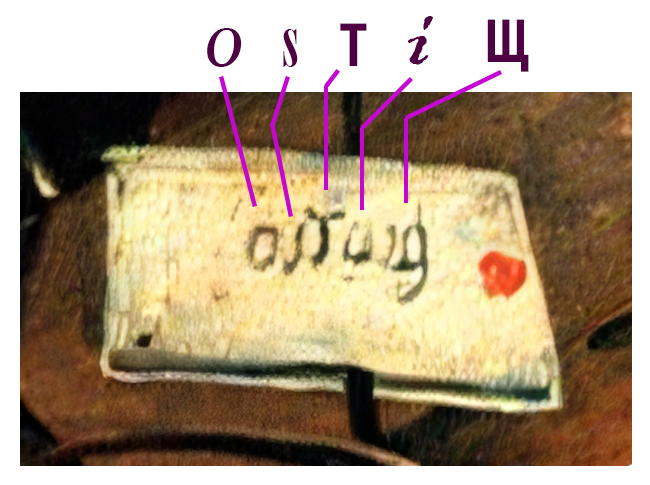
The first letter of this word should already be familiar to you from the beginning of this chapter. Apparently, Bosch also felt uncomfortable having to replace the single Cyrillic letter Щ with as many as four Latin letters— SHHE—simply so there would be a hope that someone might pronounce just one sound correctly.
I tried to find out whether anyone had ever deciphered the word written on the envelope in the beak of the “gliding monster,” but I found nothing. In our time, this means one of two things: either no one seriously tried, or they did decipher it but did not understand what it meant, and therefore could not believe they had read it correctly.
In reality, if an artist writes a certain word in such a way that someone worthy may nevertheless succeed in reading it, the artist does not have many options for making sure it is not read immediately.
The text may be turned upside down or written as a mirror image, or both of these techniques may be applied simultaneously. The letters may also be mixed from several alphabets. In addition, the text may be made readable in the opposite direction. Furthermore, the letters themselves may be stylized, yet they must remain recognizable—however difficult that recognition may be. Only in that case will the task consist not merely of reading the word, but also of justifying why it should be read that way and not otherwise.
In this particular case, Bosch combined every one of these methods of complicating the reading. Yet the greatest difficulty was realizing that, in addition to ordinary Latin letters, he had also incorporated the Cyrillic letter Щ.
How can it be proven that the deciphered word has been read correctly?
First, without rotating the image by 180 degrees and applying a mirror flip, there are letters that are simply unrecognizable within any existing alphabet.
Second, once the overall transformation of the image has been performed and every letter simultaneously becomes recognizable, only two possible directions of reading remain: the conventional direction and the opposite one. When read from left to right, the result is a completely meaningless word.
Thus, there is only one correct way to read it. Yet without a certain preparation—the very preparation I have now had the opportunity to provide for you—the word written by Bosch remained misunderstood.
There remains only a small gap to fill by drawing meaning from the following verse of the Bible:
Genesis 15:1 (KJV):“After these things the word of the LORD came unto Abram in a vision, saying, Fear not, Abram: I am thy shield, and thy exceeding great reward.”
Now look at how the word shield is written and pronounced in the Bible in Russian—it is pronounced exactly like that very common English profanity we recalled not long ago and, I hope, have not yet forgotten.
Abram’s shield in Russian is pronounced shchit (щит). This is not a random coincidence, but precisely the design of the Higher Consciousness, so that, on the basis of connecting yet another “cranberry” that has just been drawn from the waters and understood in its essence, a profound understanding may eventually come together.
Naturally, if this shield is in an incomplete state, it is appropriate to add one more hieroglyph to the word—SO, whose essence is most closely reflected in the word sobirat’
(assemble).From this comes the precise designation of the object according to both its function and its present condition—SHCHITSO. "Щitso"
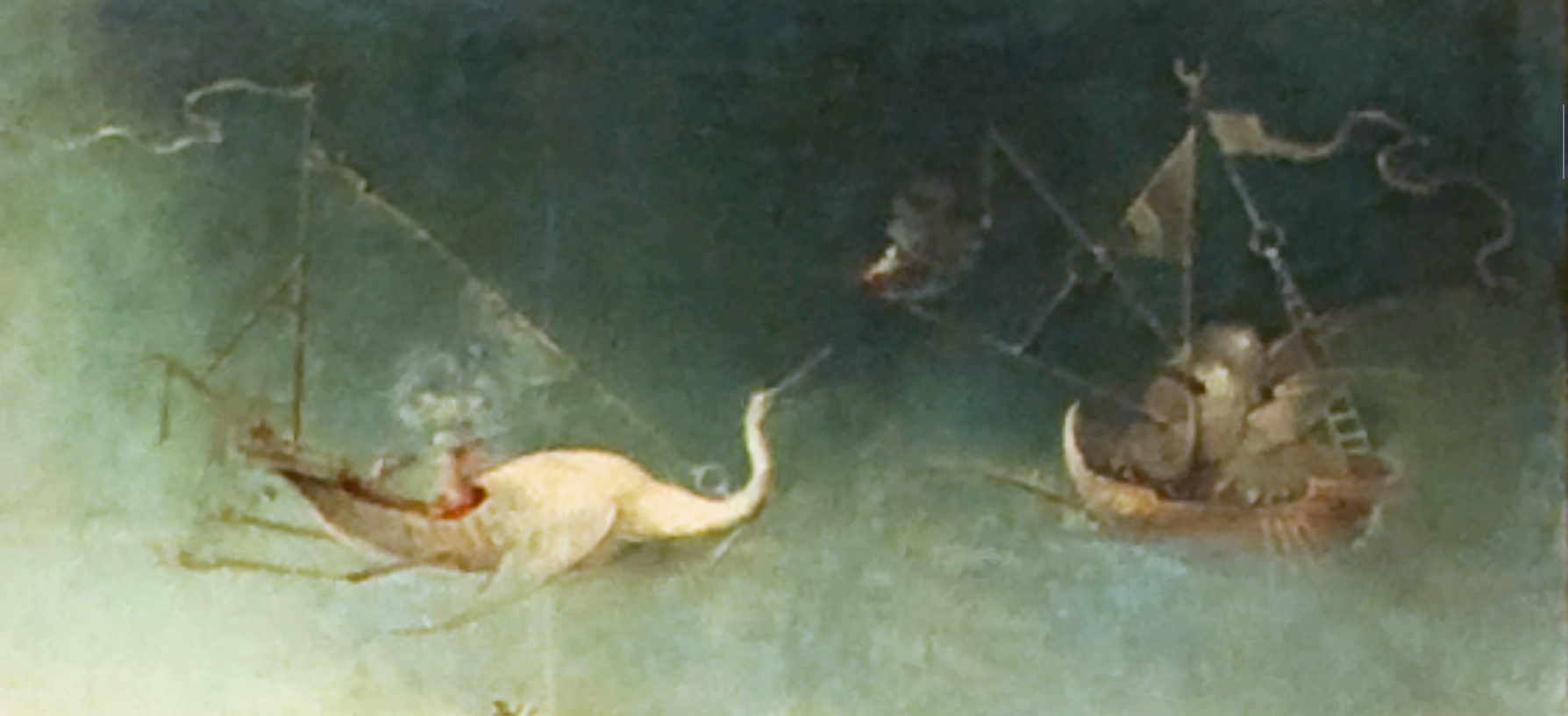
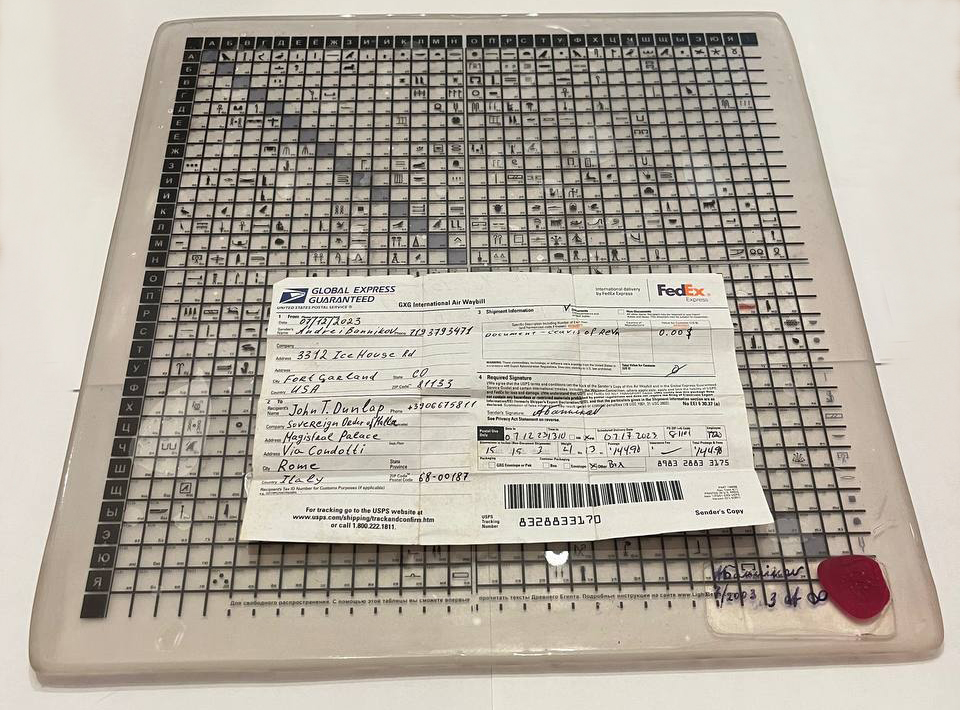
That very Щitso consisted of four transparent A4 sheets. Each sheet carried one quadrant of a table. Along the top and the left side ran the Cyrillic alphabet, while between them stretched a grid in which every letter of the alphabet met every other letter—just as, in the Bible, Jesus sent His disciples two by two into every house. Although no one has yet realized that in those very houses the paired sounds of speech were meant to encounter their corresponding Egyptian hieroglyph.
Nevertheless, someone had to be the first to assemble this Clavis of Revelation, to bring all its pieces together and make it operational.
And so this someone encased transparent sheets containing the hieroglyphic table in epoxy resin until the plastic itself disappeared from view. The hieroglyphs and their phonetic values seemed to float inside a solid block of transparent resin, like crystals suspended in space.
Had it not been for those cursed air bubbles, the result would have been magnificent. But after several unsuccessful attempts to defeat them, I finally thought, Let us see whether these people are capable of recognizing what they hold in their hands—even with the bubbles still inside.
So I went to the post office.
The gentleman accepting the parcel was visibly puzzled by the recipient’s status:
John T. Dunlap Sovereign Order of Malta Magisterial Palace Rome, Italy
Moments like that are the hardest, because your thoughts begin to race.
If I declared it a gift, the Prince might refuse to accept it.
If I assigned it a value and insured it… imagine trying to estimate what it would be worth once someone finally understands what it actually is.
What, after all, is this object?
Five gallons of epoxy resin had already been consumed in the process, along with ten years of daily searching, comparing, matching, and rearranging.
In the end I declared it simply as a document.
Because that is exactly what it is.
A document.
Clavis of Revelation.
A document recording the beginning of the biblical Revelation.
It was mailed on July 17, 2023, and, according to the tracking record, was received by John Dunlap himself approximately one month later.”
A natural question for any curious person would be:
“Well? What was the response?”
The response was exactly the kind to which an unconventional person eventually becomes accustomed in the modern world.
“What? No reply at all?”
No, not exactly. No reply at all is when a package is simply refused.
If, however, a person signs for the parcel and accepts it without knowing who sent it or what is inside, then that alone is already an act of courage on his part—and a breakthrough on mine.
I suspect that people occupying such positions are cautious with their responses, especially when they realize that what stands before them may be something of genuine importance.
Although I also suspect that, in this particular case, God sees the situation rather differently. After reading some of the Egyptian texts, that will become obvious.
Throughout this book I shall repeatedly use the term Galo-Organism.
It is, in essence, a cosmic living being of which every intelligent creature—including every human being—is a part.
And like every living organism, our Galo-Organism possesses vital organs, each of which must faithfully perform its own specific function.
So let me ask you:
What is the primary function of the organ known as the Vatican?
Perhaps a thought has already crossed your mind:
“To preserve, at all costs, the timeless standard of morality established since antiquity.”
Yes, that is true.
But it is roughly equivalent to trying to preserve your own body from the process of aging.
Such a thing is indeed possible—but only through knowledge that the guardian himself does not yet possess.
So let me stop delaying and state it plainly.
The Vatican was created to maintain communication between the Higher Being—God and humanity.
Yet this never meant that the Pope was expected to be a prophet endowed with telepathic abilities.Rather, the Pope was meant to be someone who understood a simple truth:
In a world of billions of people, only once in many generations does there appear someone capable of restoring that connection.
And that person, in essence, has nowhere to turn.
Do you remember the preserved standard of spirituality?
One expression of that standard is precisely the willingness to examine the work of countless individuals whose ideas appear to be nothing more than ordinary delusions, while understanding that one day, among them, there will be the one person who truly can.
In other words, should the Vatican ever forget its primary function, the Galo-Organism itself would lose its vitality.
Hieronymus Bosch was one of those people. Throughout this book, I shall also touch upon the works of other remarkable individuals who, thanks to the Vatican, were able to prepare the fulfillment of the Celestine Plan—each within his own appointed period of history.
“You said that God sees the situation differently. Why?”
Do you remember those clawed legs, spreading apart and drawing together like a swizzle? In the same way, its two meanings spread apart and come together—the superficial and the profound. As for our “Cleopatra,” so far I have uncovered only its superficial meaning, and it does not coincide with the meaning revealed in Bosch’s work, even though, subconsciously, you have already begun to sense the obvious correspondences and, through them, the connection.
Now I shall bring the deeper meanings together.
Do you remember what I said about the essence of the CAT hieroglyph, which is also the LION hieroglyph? The ability to understand more deeply, and not in the way demanded by the imposed academic standard of thinking, also belongs to the KSH thought-form.
Incidentally, this is why “the Lion of the tribe of Judah, the Root of David, has prevailed.” But we shall come to that gradually, and later.
At the deeper level, the word SHCHETS refers to hieroglyphs that have been processed—organized according to both their sound and their meaning—and presented in their fully completed form.
Do you remember that hieroglyph of equality — the square — and the word icons? Hieroglyphs placed within squares are precisely those “icons” of which the Egyptian master speaks at the deeper level. Recall what I have already said about the NR mind-form of range. I derive hieroglyphs by working with ranges, and as the system gradually comes together, the range for each thought-form narrows until it reaches one specific square.
Thus, the deeper meaning of “Cleopatra” is, in essence, an instruction describing the very algorithm by which hieroglyphs are brought into their completed form — narrowed (NR) down to the one correct square in the periodic table.
At the same time, the most important essence is this: the “hot” squares — the very ones I am most eager to fill with a hieroglyph — will inevitably have ron(drop).
Do you remember that word, read as ikono-roniashcheshi? It means discarding the hieroglyphs that have occupied the wrong squares.
Taken as a whole, the deeper meaning is this: the stronger the desire to fill the squares with hieroglyphs — icons — as quickly as possible, the more of them you will have to discard.
And so, you have now truly become acquainted with the first genuine Egyptian text—short though it may be. I have presented it to you exactly as it is, hiding nothing, despite the fact that the misconceptions you have accumulated will most likely meet a tragic end when confronted with what you have just learned. For everyone assumes that the treasured apple has been lying on a golden platter from the very beginning, simply because God was supposed to have placed it there for you.
Indeed, He did place it there—but first He intended that the platter itself should be reconstructed, piece by piece. Knowledge and understanding are entirely different things. Knowledge can be downloaded, but understanding is the result of practical reflection, of personal trial and error. Knowledge without understanding means absolutely nothing.
Imagine that I explained to you everything about how to perform an adagio, including every trick used on the theatre stage. It would probably take about ten hours, and afterward you would know everything necessary to retell it in words. But to truly understand it, and to apply that understanding in reality, requires years of your life. Hieroglyphs can simply be memorized, but that is not the same as spending years practicing in order to understand them.
Someone who had been initiated into the Mysteries was told that I could read Egyptian hieroglyphs. He came to see me in order to determine whether I truly matched the legend. Saying, “I know everything,” he immediately began recounting to me a brief summary of what he knew. I must admit that what he said did make sense, although to any outsider a story about a close relationship with the Archangel Michael would, of course, sound like complete nonsense.
The problem was that even he himself considered the story to be nonsense, and he could not endure the length of time I spent thinking about what I should answer. He drove his truck out of the parking lot without hearing a single word from me. It is a pity that I will never have the opportunity to apologize to him.
The truth is that a legend consists of words chosen with absolute precision, yet to the person who has merely memorized them, they remain incompletely understood. In practice, however, they turn out to be something entirely different.
What am I trying to say by all this? If you are someone who has absorbed various initiations into the Mysteries, and this book literally makes your whole body tremble, endure it to the very end. Only then will you understand what those initiations were truly preparing you for.